


Sale: 606 / Evening Sale, June 12. 2026 in Munich → Lot 125000958
Raumbeispiel
125000958
Lyonel Feininger
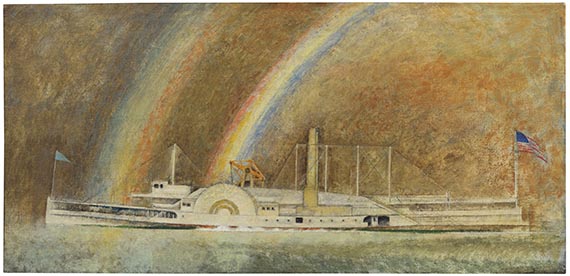
Queen of the Hudson (Mary Powell), 1940.
Oil and pencil on canvas
Estimate:
€ 140,000 - 180,000
$ 161,000 - 207,000
Information on buyer's premium, taxation and resale right compensation will be available four weeks before the auction.
125000958
Lyonel Feininger
Queen of the Hudson (Mary Powell), 1940.
Oil and pencil on canvas
Estimate:
€ 140,000 - 180,000
$ 161,000 - 207,000
Information on buyer's premium, taxation and resale right compensation will be available four weeks before the auction.
Lyonel Feininger
1871 - 1956
Queen of the Hudson (Mary Powell). 1940.
Oil and pencil on canvas.
With a label on the stretcher and a dedication by the artist; inscribed with Feininger's pseudonym “yclept Papileo” and dated “N. Y. June 11th, 1940”. 35.5 x 73.6 cm (13.9 x 28.9 in).
The complete inscription on the reverse reads: "To my dear Lux, on the auspicious occasion of his 30th Birthday, this preliminary sketch to what may some day become a full-fledged painting, representing 'The Queen of the Hudson': the Side-Wheeler 'Mary Powell', is dedicated with great affection by his Old Laddie, yclept Papileo N.Y. June 11th 1940". [AR].
• Directly from the estate of T. Lux Feininger, the artist’s son.
• Offered on the international auction market for the first time.
• “Queen of the Hudson”: a powerful symbol of Feininger’s lifelong love of maritime life.
• Stylized and mystified: beneath a double rainbow, the Hudson River boat becomes an archetype, a wistful symbol of resilience and new beginning.
• With a personal dedication by the artist on the occasion of his son’s 30th birthday.
Achim Moeller, Director of the Lyonel Feininger Project, New York–Berlin, has confirmed the authenticity of this work, which is registered in the Lyonel Feininger Project archive under the number 2048-02-26-26. The painting is listed in: Lyonel Feininger: The Catalogue Raisonné of Paintings by Achim Moeller under the number 412. A certificate of authenticity accompanies the work.
Additional information was provided by Achim Moeller, The Lyonel Feininger Project, New York - Berlin.
PROVENANCE: Theodore Lux (T. Lux) Feininger, Cambridge (MA) (gifted from the artist).
Estate of T. Lux Feininger, Cambridge (MA) (inherited).
EXHIBITION: Lyonel Feininger, Marlborough-Gerson Gallery, New York, April 1–June 1, 1969, cat. no. 52, pp. 12 and 69 (illustrated in black and white, listed as “Untitled [a sketch]”).
On loan from the Fogg Art Museum, Harvard University, Cambridge (MA) (with a label on the reverse).
Lyonel Feininger: Zurück in Amerika. 1937–1956, Moritzburg Foundation, Saxony-Anhalt State Art Museum, Halle (Saale), May 16–August 30, 2009, cat. no. 8 (here as “Queen of the Hudson”), pp. 68ff. (illustrated in color) and p. 221.
LITERATURE: Achim Moeller, “The Queen of the Hudson (Mary Powell), 1940 (Moeller 412).” Lyonel Feininger: The Catalogue Raisonné of Paintings, http://www.feiningerproject.org/ (accessed February 26, 2025).
Hans Hess, Lyonel Feininger. With a catalogue raisonné by Julia Feininger, Stuttgart 1959, CR no. 394 (illustrated on p. 286, here as “Untitled (Sketch)”).
- -
T. Lux Feininger, Konstruierte Schiffe, in: Mare 20, June/July 2000, pp. 74–79, here p. 77.
Sebastian Ehlert, Lyonel Feininger: A vele spiegate / Lyonel Feininger: Auf großer Fahrt, in: Harald Fiebig, Ilse Ruch (eds.), Lyonel Feininger: A vele spiegate / Lyonel Feininger: Auf großer Fahrt, exhibition catalog, Bellinzona 2019, pp. 33–73.
1871 - 1956
Queen of the Hudson (Mary Powell). 1940.
Oil and pencil on canvas.
With a label on the stretcher and a dedication by the artist; inscribed with Feininger's pseudonym “yclept Papileo” and dated “N. Y. June 11th, 1940”. 35.5 x 73.6 cm (13.9 x 28.9 in).
The complete inscription on the reverse reads: "To my dear Lux, on the auspicious occasion of his 30th Birthday, this preliminary sketch to what may some day become a full-fledged painting, representing 'The Queen of the Hudson': the Side-Wheeler 'Mary Powell', is dedicated with great affection by his Old Laddie, yclept Papileo N.Y. June 11th 1940". [AR].
• Directly from the estate of T. Lux Feininger, the artist’s son.
• Offered on the international auction market for the first time.
• “Queen of the Hudson”: a powerful symbol of Feininger’s lifelong love of maritime life.
• Stylized and mystified: beneath a double rainbow, the Hudson River boat becomes an archetype, a wistful symbol of resilience and new beginning.
• With a personal dedication by the artist on the occasion of his son’s 30th birthday.
Achim Moeller, Director of the Lyonel Feininger Project, New York–Berlin, has confirmed the authenticity of this work, which is registered in the Lyonel Feininger Project archive under the number 2048-02-26-26. The painting is listed in: Lyonel Feininger: The Catalogue Raisonné of Paintings by Achim Moeller under the number 412. A certificate of authenticity accompanies the work.
Additional information was provided by Achim Moeller, The Lyonel Feininger Project, New York - Berlin.
PROVENANCE: Theodore Lux (T. Lux) Feininger, Cambridge (MA) (gifted from the artist).
Estate of T. Lux Feininger, Cambridge (MA) (inherited).
EXHIBITION: Lyonel Feininger, Marlborough-Gerson Gallery, New York, April 1–June 1, 1969, cat. no. 52, pp. 12 and 69 (illustrated in black and white, listed as “Untitled [a sketch]”).
On loan from the Fogg Art Museum, Harvard University, Cambridge (MA) (with a label on the reverse).
Lyonel Feininger: Zurück in Amerika. 1937–1956, Moritzburg Foundation, Saxony-Anhalt State Art Museum, Halle (Saale), May 16–August 30, 2009, cat. no. 8 (here as “Queen of the Hudson”), pp. 68ff. (illustrated in color) and p. 221.
LITERATURE: Achim Moeller, “The Queen of the Hudson (Mary Powell), 1940 (Moeller 412).” Lyonel Feininger: The Catalogue Raisonné of Paintings, http://www.feiningerproject.org/ (accessed February 26, 2025).
Hans Hess, Lyonel Feininger. With a catalogue raisonné by Julia Feininger, Stuttgart 1959, CR no. 394 (illustrated on p. 286, here as “Untitled (Sketch)”).
- -
T. Lux Feininger, Konstruierte Schiffe, in: Mare 20, June/July 2000, pp. 74–79, here p. 77.
Sebastian Ehlert, Lyonel Feininger: A vele spiegate / Lyonel Feininger: Auf großer Fahrt, in: Harald Fiebig, Ilse Ruch (eds.), Lyonel Feininger: A vele spiegate / Lyonel Feininger: Auf großer Fahrt, exhibition catalog, Bellinzona 2019, pp. 33–73.
Lyonel Feininger’s oeuvre is characterized by a broad stylistic repertoire that is considered seminal for the development of Modernism. It is striking, however, that his imagery always revolves around a few select motif groups that Feininger uses to explore a range of artistic and stylistic expressions. In addition to architecture, maritime motifs exert a particularly strong fascination on the artist. This is a passion he shares not only with his son, T. Lux Feininger, but one that also had lasting influence on his artistic work across decades and through various creative phases.
While growing up in the United States, Feininger would watch boats passing by on the Hudson River in New York. One of these ships was the “Mary Powell,” depicted here, also known as the “Queen of the Hudson” due to its impressive engine power. For Lyonel Feininger, his years in New York marked the beginning of a lifelong fascination with seafaring. This fascination would remain with him throughout his time in Germany and his stays on the Baltic Sea. The theme also found its way into his paintings, watercolors, drawings, and woodcuts at the Bauhaus, and even after his return to the U.S. in 1937, maritime motifs remained a constant. He dedicated the present work, from 1940, to his son, T. Lux Feininger, on the occasion of his 30th birthday. Years later, T. Lux Feininger vividly recalled the creation of the painting, which has remained in the possession of the Lyonel Feininger family to this day:
"One of the first paintings completed toward the end of the period of rebellion against what could not be changed was ‘Queen of the Hudson’. [...] It is a nostalgic work, for as a young man, Lyonel Feininger had known and admired the Hudson River Dayline steamer of that name. The ‘Mary Powell’ was a record-breaker and held the Blue Ribbon for many years until it was scrapped in 1922. The double rainbow suggests Hero Worship, a palpable archaic trait that is also present in the rigorously non-perspective side view. Without exception, Hudson River boats have had—and still have today—their names painted in large, black letters on the white sidewall. No name is visible in our picture. One should not believe that this is a coincidence. The omission of identity signifies a symbolic, archetypal function. ‘I live in New York, but Old New York lives in me,’ my father wrote to me toward the end of his life.” (T. Lux Feininger in a letter to Wolfgang Büche, February 15, 2008, cited in: Wolfgang Büche (ed.), Lyonel Feininger. Back in America. 1937–1956, Munich 2009, p. 68).
While growing up in the United States, Feininger would watch boats passing by on the Hudson River in New York. One of these ships was the “Mary Powell,” depicted here, also known as the “Queen of the Hudson” due to its impressive engine power. For Lyonel Feininger, his years in New York marked the beginning of a lifelong fascination with seafaring. This fascination would remain with him throughout his time in Germany and his stays on the Baltic Sea. The theme also found its way into his paintings, watercolors, drawings, and woodcuts at the Bauhaus, and even after his return to the U.S. in 1937, maritime motifs remained a constant. He dedicated the present work, from 1940, to his son, T. Lux Feininger, on the occasion of his 30th birthday. Years later, T. Lux Feininger vividly recalled the creation of the painting, which has remained in the possession of the Lyonel Feininger family to this day:
"One of the first paintings completed toward the end of the period of rebellion against what could not be changed was ‘Queen of the Hudson’. [...] It is a nostalgic work, for as a young man, Lyonel Feininger had known and admired the Hudson River Dayline steamer of that name. The ‘Mary Powell’ was a record-breaker and held the Blue Ribbon for many years until it was scrapped in 1922. The double rainbow suggests Hero Worship, a palpable archaic trait that is also present in the rigorously non-perspective side view. Without exception, Hudson River boats have had—and still have today—their names painted in large, black letters on the white sidewall. No name is visible in our picture. One should not believe that this is a coincidence. The omission of identity signifies a symbolic, archetypal function. ‘I live in New York, but Old New York lives in me,’ my father wrote to me toward the end of his life.” (T. Lux Feininger in a letter to Wolfgang Büche, February 15, 2008, cited in: Wolfgang Büche (ed.), Lyonel Feininger. Back in America. 1937–1956, Munich 2009, p. 68).

Headquarters
Joseph-Wild-Str. 18
81829 Munich
Phone: +49 89 55 244-0
Fax: +49 89 55 244-177
info@kettererkunst.de
Louisa von Saucken / Undine Schleifer
Holstenwall 5
20355 Hamburg
Phone: +49 40 37 49 61-0
Fax: +49 40 37 49 61-66
infohamburg@kettererkunst.de
Dr. Simone Wiechers / Nane Schlage
Fasanenstr. 70
10719 Berlin
Phone: +49 30 88 67 53-63
Fax: +49 30 88 67 56-43
infoberlin@kettererkunst.de
Cordula Lichtenberg
Gertrudenstraße 24-28
50667 Cologne
Phone: +49 221 510 908-15
infokoeln@kettererkunst.de
Hessen
Rhineland-Palatinate
Miriam Heß
Phone: +49 62 21 58 80-038
Fax: +49 62 21 58 80-595
infoheidelberg@kettererkunst.de
We will inform you in time.