


Frame image
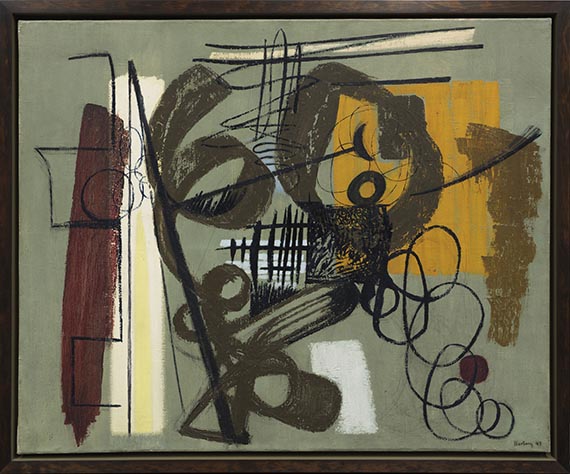
41
Hans Hartung
T1947-27, 1947.
Oil on canvas
Estimate:
€ 700,000 - 900,000
$ 784,000 - 1,008,000
41
Hans Hartung
T1947-27, 1947.
Oil on canvas
Estimate:
€ 700,000 - 900,000
$ 784,000 - 1,008,000
Hans Hartung
1904 - 1989
T1947-27. 1947.
Oil on canvas.
Signed and dated in the lower right. 80.5 x 100 cm (31.6 x 39.3 in). [JS].
• PIONEERING A perfect illusion of spontaneous drawing, pioneering for Hartung and European Informel art.
• BIENNALE Exhibited at the 1948 Biennale, the first exhibition after World War II, which was seminal for the international avant-garde.
• GUGGENHEIM Formerly part of the Peggy Guggenheim Collection, Venice.
• RARE Works from the 1940s are extremely rare on the international auction market.
• MUSEUM QUALITY Comparable paintings are at, among others, the Museum of Modern Art (1948) and the Metropolitan Museum (1949), New York.
The painting is registered in the archive of the Fondation Hartung Bergman, Antibes, and will be included in the forthcoming catalogue raisonné.
PROVENANCE: Lefebvre-Foinet, Paris (circa 1948, listed as the owner on the label of the Biennale).
Peggy Guggenheim, Venice (until 1961).
Comune di Venezia (acquired from the aforementioned in 1961).
Daniel Cordier (1920–2020), Paris.
Galerie Dr. Rusche, Cologne (with a label on the stretcher).
Private collection, Germany.
Private collection, Northern Germany (from the aforementioned).
EXHIBITION: Galerie Denise René, Paris 1948.
XXIVth Venice International Art Biennale, Venice 1948, no. 448 (with a label on the stretcher).
Galerie Lutz & Meyer, Stuttgart 1949.
Galerie Melki, Basel 1976.
LITERATURE: Madeleine Rousseau, James Johnson Sweeney, and Ottmar Dominik, Hans Hartung, Vol. I of an international series on new art, Stuttgart 1950, n.p., with illustration on a black-and-white plate.
James Johnson Sweeney, Einführung, in: Hans Hartung, vol. I of an international series on new art, Stuttgart 1950, pp. 1ff.
James Johnson Sweeney, introduction, in: Hans Hartung, vol. I of an international series on new art, Stuttgart 1950, pp. 1ff.
Called up: December 4, 2026 - ca. 18.20 h +/- 20 min.
Kandinsky, Hartung, and Soulages—Pioneers of Abstract Painting
“Hans Hartung, European Pioneer of Abstract Painting, Dies at 85,” read the headline in The New York Times when Hartung died in 1989. Hans Hartung is one of the few German artists of his generation who, after only a few sporadic figurative experiments, devoted himself consistently to abstraction from the very beginning. A lecture by Wassily Kandinsky, which the Leipzig-born artist attended during his student years in 1925, proved pivotal. Hartung made the bold decision to work exclusively in abstract art as early as the early 1930s. After moving to the art capital of Paris in 1935, he continued to develop his style in close collaboration with the leading figures of the Parisian avant-garde, before ultimately becoming—alongside Pierre Soulages—one of the pioneers of European Informel art in the late 1940s.
Much like Kandinsky—with whom Hartung maintained a personal relationship in the 1930s—Hartung's work closely intertwines painting and music. In his younger years, Hartung was an enthusiastic pianist and dancer and cultivated an almost obsessive relationship with music, his interests ranging from classical music and jazz to electronic music. In a 1948 letter from Pierre Soulages, a friend of Hartung's since the late 1940s, he reports: "His radio is always on—when he visits me, he can't resist playing his favorite records. […] Even moments of rest and, above all, of work were almost unbearable for him without music.” Unlike Kandinsky, however, painting and music are not linked in Hartung’s work through a theoretical-programmatic approach; rather—since Hartung almost always listened to music while drawing and painting—they form a strikingly direct and immediate connection on the canvas: From dynamism and rhythm, Hartung develops unmistakable harmonies of color and form, brimming with energy. Our early composition “T 1947-27”, created just two years after the end of the war and exhibited at the XXIV. Biennale di Venezia in 1948 — a seminal event for the postwar avant-garde — is also distinguished by its progressive gestural style, its dominant use of black lines and layering, and various painterly techniques that would become defining features of Hartung’s oeuvre.
“T 1947-27” – A Perfect Illusion of Spontaneous Drawing and Dynamism
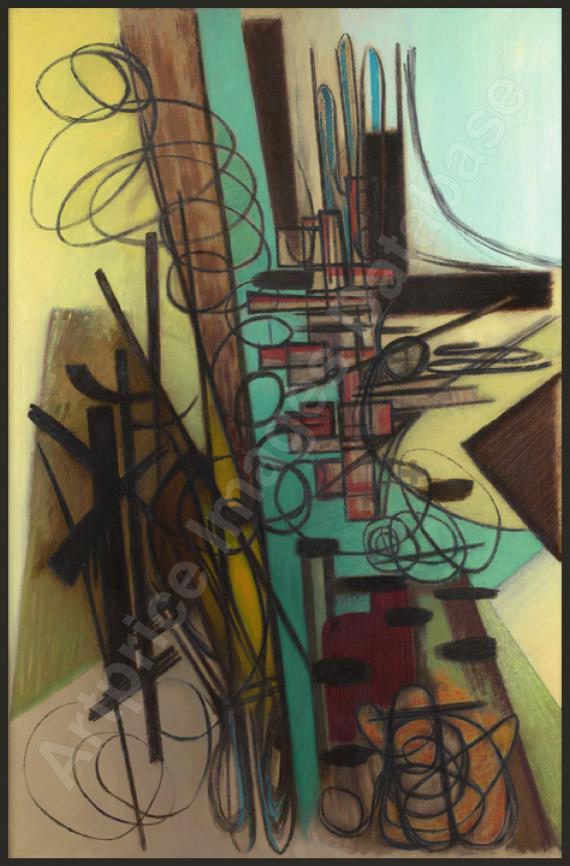
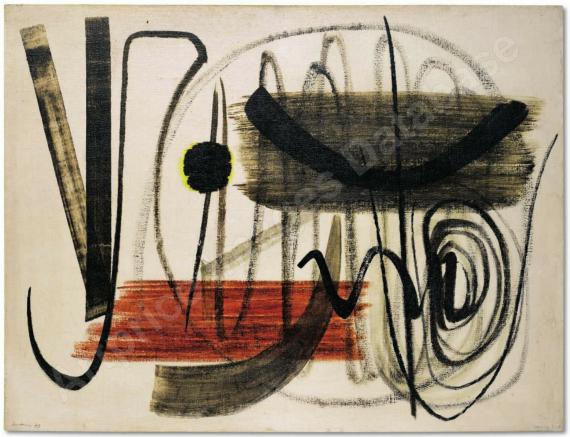
This composition appears as if it were rendered onto the canvas with playful ease and an almost dance-like gesture. The lines and forms against a turquoise backdrop feel highly dynamic while still retaining a dreamy, ethereal character. Hartung brought the delicate, swirling line structures and the masterfully applied color fields—ranging from luminous pastel yellow through orange to earthy brown—into a fascinating harmony and balance. The staged weightlessness vaguely recalls the famous mobiles of Alexander Calder, whom Hartung met in the late 1930s when he was part of the Parisian avant-garde. In our early and seminal composition “T1947-27”—formerly part of Peggy Guggenheim’s legendary collection in Venice—Hartung unites seemingly contradictory elements, blending density and transparency in a painterly manner. The various floating forms, which, in the fascinating immediacy of their expression, resemble a painted drawing, overlap in many ways; at the same time, they offer a glimpse into the infinity of ethereal realms. “T1947-27” is a particularly striking example of Hartung’s mastery in translating the unique immediacy and dynamism of drawing into painting. However, knowledge of Hartung’s approach to his work from the 1940s through the 1960s only adds to the fascination with this masterfully perfected illusion of spontaneity and dynamism: For up until 1960, Hartung’s compositions were based on precise preparatory drawings, some of which were transferred to large formats using the method of quadrature.
“T 1947-27” – An early key work of European Informel Art
However, Hartung wanted to preserve the expressive quality of the hand-drawn line and the immediate creative energy captured in drawing. He had already come very close to his artistic goal in his wonderful and rare compositions from the 1940s, which celebrate the gestural energy of the line. This characteristic feature would be of key distinction in European Informel art over the next two decades. Informel painting is based on free gesture as a direct expression of the unconscious, which is transcribed onto the canvas in the tradition of Surrealist “écriture automatique.” “T1947-27” is an outstanding early example of this and is therefore regarded—along with the compositions created around the same time, most of which are now held in major international collections, including the Museum of Modern Art and the Metropolitan Museum in New York—as a seminal work that paved the way for European Informel painting.
As early as 1956, Hartung’s exceptional artistic achievement earned the Guggenheim International Award from the Solomon R. Guggenheim Foundation. Twelve years after this composition was exhibited in Venice, Hartung received the Grand International Prize for Painting at the Biennale di Venezia in 1960. Hartung’s first solo exhibition in the United States followed with a show at the Metropolitan Museum of Art in New York in 1975. Today, his works are part of major museum collections worldwide. [JS]
“Hans Hartung, European Pioneer of Abstract Painting, Dies at 85,” read the headline in The New York Times when Hartung died in 1989. Hans Hartung is one of the few German artists of his generation who, after only a few sporadic figurative experiments, devoted himself consistently to abstraction from the very beginning. A lecture by Wassily Kandinsky, which the Leipzig-born artist attended during his student years in 1925, proved pivotal. Hartung made the bold decision to work exclusively in abstract art as early as the early 1930s. After moving to the art capital of Paris in 1935, he continued to develop his style in close collaboration with the leading figures of the Parisian avant-garde, before ultimately becoming—alongside Pierre Soulages—one of the pioneers of European Informel art in the late 1940s.
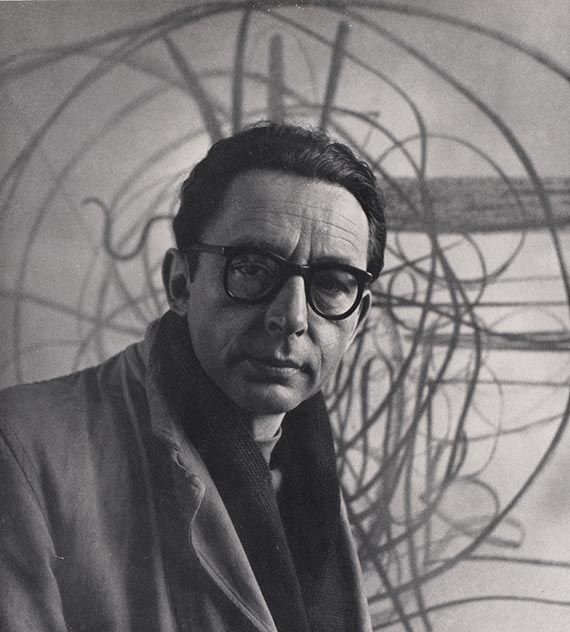
Hans Hartung, studio photograph, ca. 1948, Paris, photo: Willy Maywald. © Association Willy Maywald / VG Bild-Kunst, Bonn 2026
Much like Kandinsky—with whom Hartung maintained a personal relationship in the 1930s—Hartung's work closely intertwines painting and music. In his younger years, Hartung was an enthusiastic pianist and dancer and cultivated an almost obsessive relationship with music, his interests ranging from classical music and jazz to electronic music. In a 1948 letter from Pierre Soulages, a friend of Hartung's since the late 1940s, he reports: "His radio is always on—when he visits me, he can't resist playing his favorite records. […] Even moments of rest and, above all, of work were almost unbearable for him without music.” Unlike Kandinsky, however, painting and music are not linked in Hartung’s work through a theoretical-programmatic approach; rather—since Hartung almost always listened to music while drawing and painting—they form a strikingly direct and immediate connection on the canvas: From dynamism and rhythm, Hartung develops unmistakable harmonies of color and form, brimming with energy. Our early composition “T 1947-27”, created just two years after the end of the war and exhibited at the XXIV. Biennale di Venezia in 1948 — a seminal event for the postwar avant-garde — is also distinguished by its progressive gestural style, its dominant use of black lines and layering, and various painterly techniques that would become defining features of Hartung’s oeuvre.
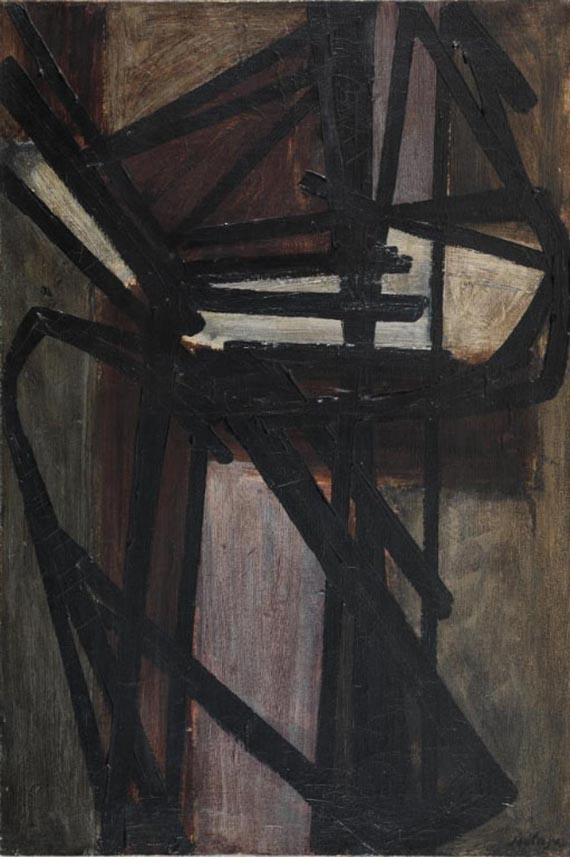
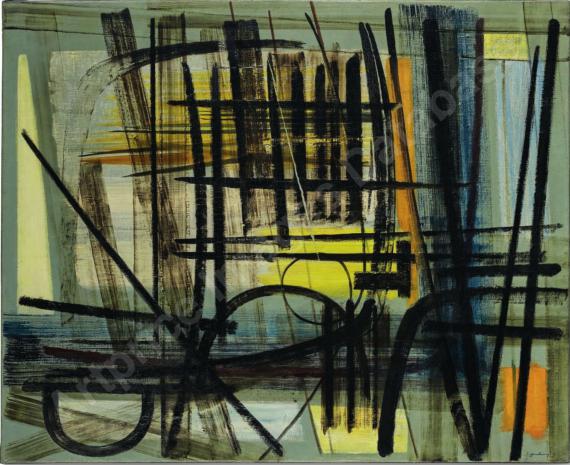
Pierre Soulages, Peinture 81 x 60 cm, 14 mars 1950 (Painting 81 x 60 cm, 14 March 1950), 1950, oil on canvas, Centre Pompidou, Paris. © VG Bild-Kunst, Bonn 2026
“T 1947-27” – A Perfect Illusion of Spontaneous Drawing and Dynamism
This composition appears as if it were rendered onto the canvas with playful ease and an almost dance-like gesture. The lines and forms against a turquoise backdrop feel highly dynamic while still retaining a dreamy, ethereal character. Hartung brought the delicate, swirling line structures and the masterfully applied color fields—ranging from luminous pastel yellow through orange to earthy brown—into a fascinating harmony and balance. The staged weightlessness vaguely recalls the famous mobiles of Alexander Calder, whom Hartung met in the late 1930s when he was part of the Parisian avant-garde. In our early and seminal composition “T1947-27”—formerly part of Peggy Guggenheim’s legendary collection in Venice—Hartung unites seemingly contradictory elements, blending density and transparency in a painterly manner. The various floating forms, which, in the fascinating immediacy of their expression, resemble a painted drawing, overlap in many ways; at the same time, they offer a glimpse into the infinity of ethereal realms. “T1947-27” is a particularly striking example of Hartung’s mastery in translating the unique immediacy and dynamism of drawing into painting. However, knowledge of Hartung’s approach to his work from the 1940s through the 1960s only adds to the fascination with this masterfully perfected illusion of spontaneity and dynamism: For up until 1960, Hartung’s compositions were based on precise preparatory drawings, some of which were transferred to large formats using the method of quadrature.
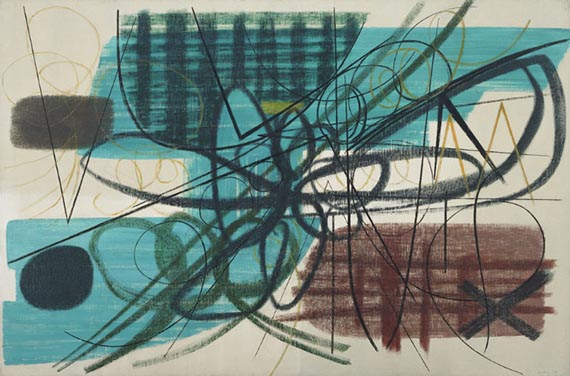
Hans Hartung, T 1948-15, 1948, oil on canvas, Museum of Modern Art, New York. © VG Bild-Kunst, Bonn 2026
“T 1947-27” – An early key work of European Informel Art
However, Hartung wanted to preserve the expressive quality of the hand-drawn line and the immediate creative energy captured in drawing. He had already come very close to his artistic goal in his wonderful and rare compositions from the 1940s, which celebrate the gestural energy of the line. This characteristic feature would be of key distinction in European Informel art over the next two decades. Informel painting is based on free gesture as a direct expression of the unconscious, which is transcribed onto the canvas in the tradition of Surrealist “écriture automatique.” “T1947-27” is an outstanding early example of this and is therefore regarded—along with the compositions created around the same time, most of which are now held in major international collections, including the Museum of Modern Art and the Metropolitan Museum in New York—as a seminal work that paved the way for European Informel painting.
As early as 1956, Hartung’s exceptional artistic achievement earned the Guggenheim International Award from the Solomon R. Guggenheim Foundation. Twelve years after this composition was exhibited in Venice, Hartung received the Grand International Prize for Painting at the Biennale di Venezia in 1960. Hartung’s first solo exhibition in the United States followed with a show at the Metropolitan Museum of Art in New York in 1975. Today, his works are part of major museum collections worldwide. [JS]

Buyer's premium, taxation and resale right compensation for Hans Hartung "T1947-27"
This lot can be purchased subject to differential or regular taxation, artist‘s resale right compensation is due.
Differential taxation:
Hammer price up to 2,000,000 €: herefrom 34 % premium.
The share of the hammer price exceeding 2,000,000 € is subject to a premium of 29 % and is added to the premium of the share of the hammer price up to 2,000,000 €.
The share of the hammer price exceeding 4,000,000 € is subject to a premium of 22 % and is added to the premium of the share of the hammer price up to 4,000,000 €.
The buyer's premium contains VAT, however, it is not shown.
Regular taxation:
Hammer price up to 2,000,000 €: herefrom 29 % premium.
The share of the hammer price exceeding 2,000,000 € is subject to a premium of 23% and is added to the premium of the share of the hammer price up to 2,000,000 €.
The share of the hammer price exceeding 4,000,000 € is subject to a premium of 15% and is added to the premium of the share of the hammer price up to 4,000,000 €.
The statutory VAT of currently 7 % is levied to the sum of hammer price and premium.
We kindly ask you to notify us before invoicing if you wish to be subject to regular taxation.
Calculation of artist‘s resale right compensation:
For works by living artists, or by artists who died less than 70 years ago, a artist‘s resale right compensation is levied in accordance with Section 26 UrhG:
4 % of hammer price from 400.00 euros up to 50,000 euros,
another 3 % of the hammer price from 50,000.01 to 200,000 euros,
another 1 % for the part of the sales proceeds from 200,000.01 to 350,000 euros,
another 0.5 % for the part of the sale proceeds from 350,000.01 to 500,000 euros and
another 0.25 % of the hammer price over 500,000 euros.
The maximum total of the resale right fee is EUR 12,500.
The artist‘s resale right compensation is VAT-exempt.
Headquarters
Joseph-Wild-Str. 18
81829 Munich
Phone: +49 89 55 244-0
Fax: +49 89 55 244-177
info@kettererkunst.de
Louisa von Saucken / Undine Schleifer
Holstenwall 5
20355 Hamburg
Phone: +49 40 37 49 61-0
Fax: +49 40 37 49 61-66
infohamburg@kettererkunst.de
Dr. Simone Wiechers
Fasanenstr. 70
10719 Berlin
Phone: +49 30 88 67 53-63
Fax: +49 30 88 67 56-43
infoberlin@kettererkunst.de
Cordula Lichtenberg
Gertrudenstraße 24-28
50667 Cologne
Phone: +49 221 510 908-15
infokoeln@kettererkunst.de
Hessen
Rhineland-Palatinate
Miriam Heß
Phone: +49 62 21 58 80-038
Fax: +49 62 21 58 80-595
infoheidelberg@kettererkunst.de
We will inform you in time.