


Frame image
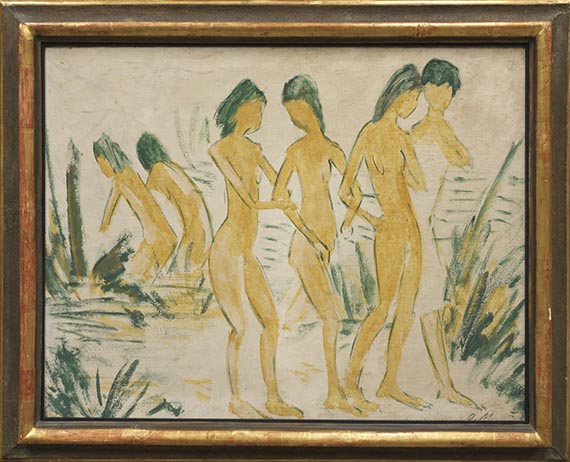
Raumbeispiel
26
Otto Mueller
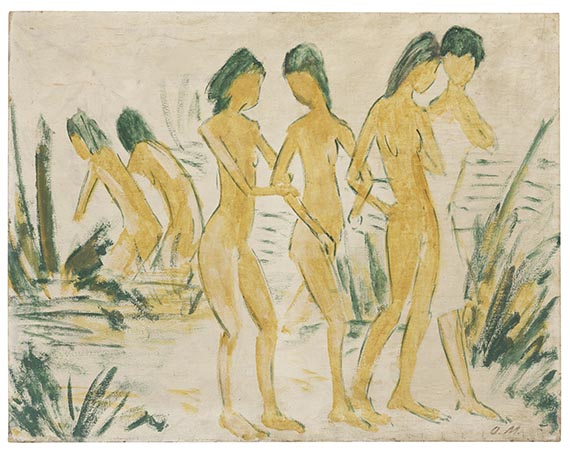
Sechs Mädchenakte am Strand, Um 1913.
Glue paint and Mixed media on burlap
Estimate:
€ 500,000 - 700,000
$ 560,000 - 784,000
26
Otto Mueller
Sechs Mädchenakte am Strand, Um 1913.
Glue paint and Mixed media on burlap
Estimate:
€ 500,000 - 700,000
$ 560,000 - 784,000
Otto Mueller
1874 - 1930
Sechs Mädchenakte am Strand. Um 1913.
Glue paint and Mixed media on burlap.
Monogrammed in the lower right. Signed and inscribed on the reverse. 85.4 x 109 cm (33.6 x 42.9 in).
• KEY YEAR 1913: The year the “Brücke” group disbanded, Mueller developed his distinctive imagery, balancing expressive freedom with timeless harmony.
• EXCEPTIONAL FORMAT A rare large-format painting featuring six nude girls, one of the central motifs of his work.
• RARE EASE An unusually cheerful, almost weightless composition of figures, full of grace and natural elegance.
• ICONIC STYLE Rhythmically arranged nudes embody Mueller’s ideal of a primal unity between humanity and nature.
• MUSEUM QUALITY Significant exhibition history, most recently at the LWL Museum in Münster on the occasion of the artist’s 150th birthday.
We are grateful to Dr. Tanja Pirsig-Marshall, Museum für Kunst und Kulturgeschichte, Dortmund, for her expert advice.
PROVENANCE: Herbert Kurz Collection, Wolframs-Eschenbach (until 1950).
Private collection (since 1950, Stuttgarter Kunstkabinett).
Galerie Nierendorf, Berlin (1954).
Emil Frey Collection, Mannheim (1964).
Private collection, Munich (since 1980).
Private collection, Northern Germany (acquired in 2007 from the above, Hauswedell).
EXHIBITION: Otto Mueller on the Occasion of His 90th Birthday, Galerie Nierendorf, Berlin, 1964, cat. no. 27 (with black-and-white illustration).
Aquarelle, Zeichnungen, Druckgraphik des 20. Jahrhunderts aus der Sammlung eines Kielers. Exhibition marking the 100th anniversary of the Schleswig-Holsteinische Landesbrandkasse, Kunsthalle zu Kiel / Schleswig-Holsteinischer Kunstverein, Feb. 3–Mar. 3, 1974, cat. no. 119.
Kunst des 20. Jahrhunderts aus der Sammlung F., Pfalzgalerie Kaiserslautern, 1976, cat. no. 3 (with color illustration on the title page).
Kunsthalle Mannheim (1981–1987, on loan from a private collection in Munich).
Otto Mueller: Natürlich nackt, Kunstmuseum Ravensburg, September 13, 2014–January 25, 2015; Brücke Museum, Berlin, March 21–July 5, 2015; Kunsthalle Emden, September 19, 2015–January 17, 2016 (not in the catalog).
Brücke und Der Blaue Reiter, Buchheim Museum der Phantasie; Kunstsammlungen Chemnitz; Von der Heydt Museum, Wuppertal, Nov. 21, 2021–Feb. 27, 2022, p. 163 (with illu.).
Otto Mueller, LWL Museum für Kunst und Kultur, Münster, September 20, 2024–February 2, 2025, cat. no. 17 (with color illustration).
LITERATURE: Mario-Andreas von Lüttichau, Tanja Pirsig-Marshall, Otto Mueller.
Vol. 1: Gemälde (Paintings), Cologne 2020, CR no. G1913/09 (135) (with color illustration).
Lothar-Günther Buchheim, Otto Mueller. Leben und Werk, Feldafing 1963, no. 67 (with b&w illustration, p. 134, dated 1919/1920).
- -
Stuttgarter Kunstkabinett Roman Norbert Ketterer, Stuttgart, 8th Auction, Paintings, Sculpture, Prints, Sketches, Watercolors, Art Literature, May 12, 1950, Lot 1711 (with b/w illustration).
Marlene Decker, Gestaltungselemente im Bildwerk von Otto Mueller, Dortmund 1993, no. 131, p. 178 (with illustration).
Hauswedell & Nolte, Hamburg, 400th Auction, Modern Art of the 19th and 20th Centuries, Part I, Selected Works, June 1, 2007, lot 47 (with full-page color illustration on p. 95).
Tanja Pirsig-Marshall, “Die BRÜCKE als Katalysator für Muellers Schaffen,” Yearbook of the Dresden State Art Collections 32, Dresden 2007, p. 132 (with illu.)
“Der böse Expressionismus, Trauma und Tabu”, exhibition catalog, Kunsthalle Bielefeld, 2017–2018 (with illu.).
“In my paintings, I depict my life and experience. I can only paint what I love.”
Otto Mueller, quoted from: Emmy Mueller, Erinnerungen an Otto Mueller, unpublished typescript, 1950, p. 21.
Called up: December 4, 2026 - ca. 17.50 h +/- 20 min.
Otto Mueller’s artistic roots lie in the gracefully flowing lines of Art Nouveau and the elongated elegance of Wilhelm Lehmbruck's sculptures. When the painter settled in Berlin in 1908, his works submitted to the renowned Berlin Secession in early 1910 were rejected by the jury. Mueller, along with other rejected artists, refused to accept defeat and founded the “Neue Secession,” chaired by Max Pechstein. There, Erich Heckel and Ernst Ludwig Kirchner encountered Mueller’s work for the first time. Heckel later recalled the spontaneous studio visit on Mommsenstraße with the following words: “My first encounter with Otto Mueller’s paintings was in Berlin. [...] It was a significant and fruitful moment for each of us, and it went without saying that he would become part of the Brücke community from then on.” (quoted from: Lothar-Günther Buchheim, Otto Mueller: Leben und Werk, Feldafing 1963, p. 66) Although Mueller was accepted as the last member in 1910, his artistic approach remained entirely independent. While his fellow artists sought the expressive clash of vibrant primary colors, Mueller preferred a contemplative poetry. He was guided by a quest for harmony, balance, and a quiet unity between humanity and untouched nature.
1913: A Turning Point for the Artists' Group “Brücke”
The year 1913 marked a decisive turning point. When Kirchner presented his draft of the “Chronicle of the Brücke”, a biased account that deeply hurt his fellow artists, disputes within the group escalated. In May 1913, the “Brücke” formally disbanded. Mueller, however, remained closely connected to the former members. In particular, his friendship with Heckel and Kirchner continued even after the group’s dissolution. That same summer, Mueller, his wife Maschka, Kirchner, and Kirchner’s partner Erna Schilling spent several weeks together on the Baltic island of Fehmarn. Amid the coastal dunes, both artists created outstanding works. However, while Kirchner captured the restless energy of Modernism, Mueller transformed the scenery into a timeless, Arcadian retreat.
Matte Distemper and Egyptian Reveries
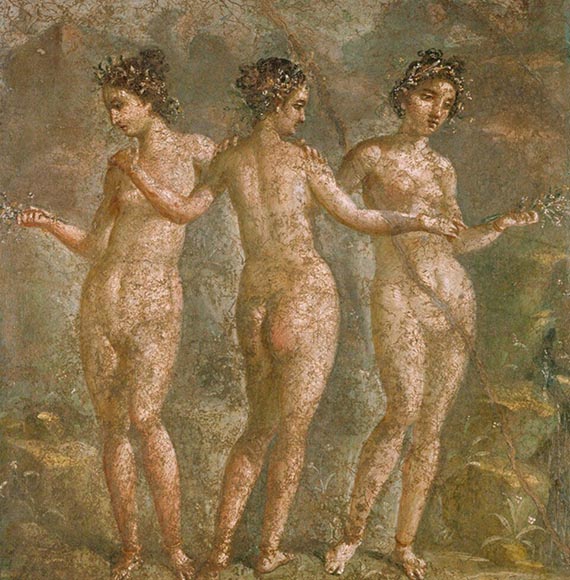
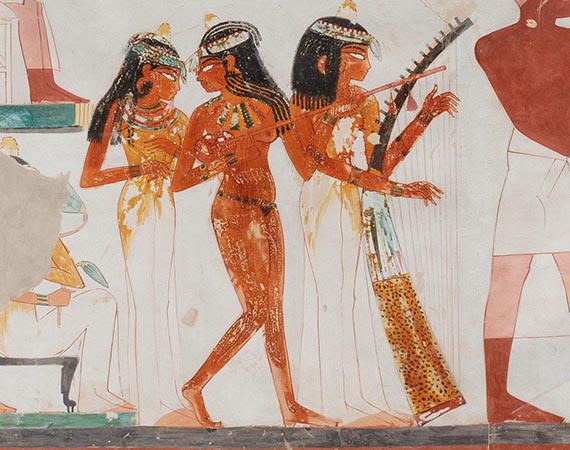
An unconventional technique underpins Mueller’s painting. Inspired by Pompeian wall frescoes, he used distemper as early as 1901—paints he mixed himself and occasionally enriched with a small amount of oil. Nearly his entire oeuvre was created in this fresco-like manner. When applied to a coarse surface, the material dries quickly. This requires swift, precise application, leaving little room for later corrections. The result is a dull, chalky surface that conveys Mueller’s admiration for ancient art. In the catalog for his solo exhibition at Galerie Paul Cassirer in Berlin in 1919, he summarized his guiding principle: “The primary goal of my endeavor is to express the feeling of landscape and humanity with the greatest possible simplicity: the art of the ancient Egyptians was, and still is, my model—even in terms of pure craftsmanship.” (quoted from: Eberhard Troeger, Otto Mueller, Freiburg i. Br. 1949, p. 18)
“Six Female Nudes on the Beach” (1913): Freedom and Pure Form
Made at the height of his creative powers, “Six Female Nudes on the Beach” embodies Mueller’s lifelong quest for natural grace. The scene depicts six girls on a sunlit shore, bathed in the sun's shimmering rays. Four figures emerge from the water, arm in arm, chatting and filled with a calm sense of ease. In the background, two bathers can be glimpsed from behind, standing slightly bent forward in the shallow water. This artistic device lends the frieze-like foreground a surprising sense of spatial depth. Unlike his related work “Five Yellow Nudes by the Water” from 1912, Mueller omits dense shoreline vegetation here. The landscape is reduced to the essence. Light-colored sandy areas, the rhythm of the water, and sparse hints of vegetation are enough. Dark lines frame the graceful bodies, creating a striking contrast between delicate skin tones and the fabric's rough texture. The figure on the far right seems to almost merge with the background, accentuated only by the outline of her garment. With this dense brushwork, Mueller achieves the weightless monumentality of ancient murals, imbued with an unadulterated joie de vivre.
A Museum-Quality Rarity
Multi-figure beach scenes from Mueller’s pivotal “Brücke” period are extremely rare in this museum scale and are highly sought after on the international art market. In addition to its origin in the key year of 1913, major exhibitions attest to the work’s significance, including the 2022 presentation at the Buchheim Museum in Bernried and the anniversary exhibition celebrating his 150th birthday at the LWL Museum of Art and Culture in Münster in 2024/25. The painting remains a consummate testament to Mueller’s oeuvre, a paradisiacal vision far removed from all the constraints of modern civilization. [KA]
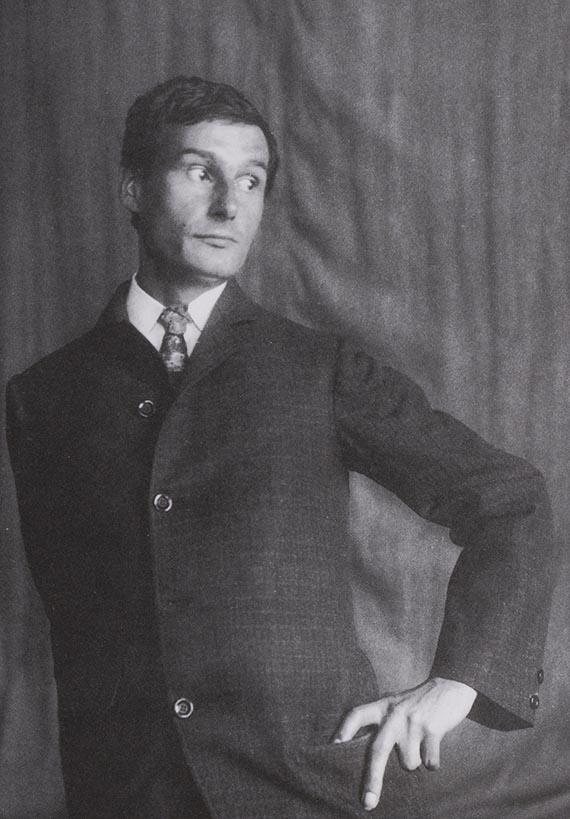
Otto Mueller, 1910, photo: unknown.
1913: A Turning Point for the Artists' Group “Brücke”
The year 1913 marked a decisive turning point. When Kirchner presented his draft of the “Chronicle of the Brücke”, a biased account that deeply hurt his fellow artists, disputes within the group escalated. In May 1913, the “Brücke” formally disbanded. Mueller, however, remained closely connected to the former members. In particular, his friendship with Heckel and Kirchner continued even after the group’s dissolution. That same summer, Mueller, his wife Maschka, Kirchner, and Kirchner’s partner Erna Schilling spent several weeks together on the Baltic island of Fehmarn. Amid the coastal dunes, both artists created outstanding works. However, while Kirchner captured the restless energy of Modernism, Mueller transformed the scenery into a timeless, Arcadian retreat.
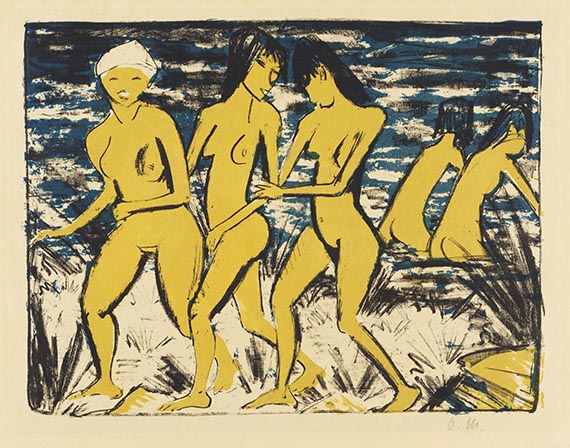
Otto Mueller, Fünf gelbe Akte am Wasser (Fünf Mädchen am Strand, Nordsee, Badende Mädchen) (Five Yellow Nudes by the Water (Five Girls on the Beach, North Sea, Girls Bathing)), 1921, color lithograph, private collection, sold at Ketterer Kunst, December 10, 2024, auction 563, Lot 220.
Matte Distemper and Egyptian Reveries
An unconventional technique underpins Mueller’s painting. Inspired by Pompeian wall frescoes, he used distemper as early as 1901—paints he mixed himself and occasionally enriched with a small amount of oil. Nearly his entire oeuvre was created in this fresco-like manner. When applied to a coarse surface, the material dries quickly. This requires swift, precise application, leaving little room for later corrections. The result is a dull, chalky surface that conveys Mueller’s admiration for ancient art. In the catalog for his solo exhibition at Galerie Paul Cassirer in Berlin in 1919, he summarized his guiding principle: “The primary goal of my endeavor is to express the feeling of landscape and humanity with the greatest possible simplicity: the art of the ancient Egyptians was, and still is, my model—even in terms of pure craftsmanship.” (quoted from: Eberhard Troeger, Otto Mueller, Freiburg i. Br. 1949, p. 18)
Depiction of the Three Graces, 1st century A.D., fresco, from Pompeii, Italy. Museo Archeologico Nazionale, Naples.
Banquet Scene with Musicians, Tomb of Nakht, ca. 1410–1370 BCE, Tempera on paper, Metropolitan Museum of Art, New York.
“Six Female Nudes on the Beach” (1913): Freedom and Pure Form
Made at the height of his creative powers, “Six Female Nudes on the Beach” embodies Mueller’s lifelong quest for natural grace. The scene depicts six girls on a sunlit shore, bathed in the sun's shimmering rays. Four figures emerge from the water, arm in arm, chatting and filled with a calm sense of ease. In the background, two bathers can be glimpsed from behind, standing slightly bent forward in the shallow water. This artistic device lends the frieze-like foreground a surprising sense of spatial depth. Unlike his related work “Five Yellow Nudes by the Water” from 1912, Mueller omits dense shoreline vegetation here. The landscape is reduced to the essence. Light-colored sandy areas, the rhythm of the water, and sparse hints of vegetation are enough. Dark lines frame the graceful bodies, creating a striking contrast between delicate skin tones and the fabric's rough texture. The figure on the far right seems to almost merge with the background, accentuated only by the outline of her garment. With this dense brushwork, Mueller achieves the weightless monumentality of ancient murals, imbued with an unadulterated joie de vivre.
A Museum-Quality Rarity
Multi-figure beach scenes from Mueller’s pivotal “Brücke” period are extremely rare in this museum scale and are highly sought after on the international art market. In addition to its origin in the key year of 1913, major exhibitions attest to the work’s significance, including the 2022 presentation at the Buchheim Museum in Bernried and the anniversary exhibition celebrating his 150th birthday at the LWL Museum of Art and Culture in Münster in 2024/25. The painting remains a consummate testament to Mueller’s oeuvre, a paradisiacal vision far removed from all the constraints of modern civilization. [KA]


Buyer's premium and taxation for Otto Mueller "Sechs Mädchenakte am Strand"
This lot can be purchased subject to differential or regular taxation.
Differential taxation:
Hammer price up to 2,000,000 €: herefrom 34 % premium.
The share of the hammer price exceeding 2,000,000 € is subject to a premium of 29 % and is added to the premium of the share of the hammer price up to 2,000,000 €.
The share of the hammer price exceeding 4,000,000 € is subject to a premium of 22 % and is added to the premium of the share of the hammer price up to 4,000,000 €.
The buyer's premium contains VAT, however, it is not shown.
Regular taxation:
Hammer price up to 2,000,000 €: herefrom 29 % premium.
The share of the hammer price exceeding 2,000,000 € is subject to a premium of 23% and is added to the premium of the share of the hammer price up to 2,000,000 €.
The share of the hammer price exceeding 4,000,000 € is subject to a premium of 15% and is added to the premium of the share of the hammer price up to 4,000,000 €.
The statutory VAT of currently 7 % is levied to the sum of hammer price and premium.
We kindly ask you to notify us before invoicing if you wish to be subject to regular taxation.
Headquarters
Joseph-Wild-Str. 18
81829 Munich
Phone: +49 89 55 244-0
Fax: +49 89 55 244-177
info@kettererkunst.de
Louisa von Saucken / Undine Schleifer
Holstenwall 5
20355 Hamburg
Phone: +49 40 37 49 61-0
Fax: +49 40 37 49 61-66
infohamburg@kettererkunst.de
Dr. Simone Wiechers
Fasanenstr. 70
10719 Berlin
Phone: +49 30 88 67 53-63
Fax: +49 30 88 67 56-43
infoberlin@kettererkunst.de
Cordula Lichtenberg
Gertrudenstraße 24-28
50667 Cologne
Phone: +49 221 510 908-15
infokoeln@kettererkunst.de
Hessen
Rhineland-Palatinate
Miriam Heß
Phone: +49 62 21 58 80-038
Fax: +49 62 21 58 80-595
infoheidelberg@kettererkunst.de
We will inform you in time.