


Frame image
7
Piero Dorazio
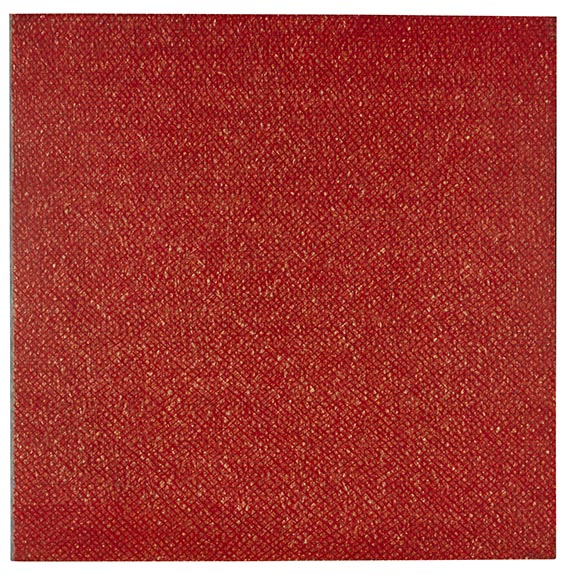
Tic-Tac Rosso, 1959/60.
Oil on canvas
Estimate:
€ 300,000 / $ 348,000 Sold:
€ 2,580,000 / $ 2,992,800 (incl. surcharge)
7
Piero Dorazio
Tic-Tac Rosso, 1959/60.
Oil on canvas
Estimate:
€ 300,000 / $ 348,000 Sold:
€ 2,580,000 / $ 2,992,800 (incl. surcharge)
Piero Dorazio
1927 - 2005
Tic-Tac Rosso. 1959/60.
Oil on canvas.
Signed, dated, and titled on the reverse of the canvas, along with a later personal dedication. Also signed and dated “June 29, 1980” on the reverse. 194.5 x 194.5 cm (76.5 x 76.5 in).
• A monumental key piece from the artist's most sought-after creative period, unprecedented on the international auction market in terms of quality and size.
• Exhibited at the 30th Venice Biennale in 1960, where Dorazio had his own exhibition space and which marked his international breakthrough.
• Between Constructivism and Op Art: a complex, vibrant structure composed of a multitude of intersecting lines.
• Part of a Southern German private collection for 25 years.
• Comparable works are part of the world's most prestigious collections, including the Hirshhorn Museum (Smithsonian Institution), Washington, D.C., the Centre Pompidou, Paris, and the Museum of Modern Art, New York.
Accompanied by a photo certificate issued by the Archivio Piero Dorazio, Milan. The work is documented in the Archivio Piero Dorazio, Milan.
PROVENANCE: Private collection, Germany (1980, acquired directly from the artist).
Private collection, Southern Germany (1998, acquired from the above).
EXHIBITION: XXX. Esposizione Biennale Internazionale d’Arte di Venezia, Venice, June 18–October 16, 1960, p. 136 (with the label on the stretcher).
Venice Biennale Prize-Winners 1960, McCormick Place Art Gallery, Chicago; Milwaukee Art Center, Milwaukee; Walker Art Center, Minneapolis; World House Galleries, New York; Everson Museum of Art, Syracuse, Feb. 14–Mar. 4, 1961 (with a black-and-white illustration, detail).
Nul, Galerie Ad Libitum, Antwerp, Jan. 13–Feb. 13, 1962, Stedelijk Museum, Amsterdam, March 1962 (illustrated).
De Nieuwe Stijl Werk van de Internationale Avantgarde, Galerij de Bezige Bij, Amsterdam, April–May 1962 (illustrated).
Bienal de Arte, Museo de Arte Moderno, São Paulo, September–December 1963.
Piero Dorazio. Mostra retrospettiva 1946–1975, Palazzo del Popolo, Sala delle Pietre, Todi, March–May 1975.
Cosa succede, Studio F.22 Galleria d’Arte Moderna, Palazzolo sull’Oglio, October 1975, cat. no. 28 (illustrated).
Europe/America: L'Astrazione Determinata 1960/1976, Galleria Comunale d'Arte Moderna, Bologna, May 23–Sept. 30, 1976, cat. no. 4 (illustrated in b/w, with the label on the stretcher).
Piero Dorazio, Musée d'Art Moderne de la Ville de Paris, June 7–September 2, 1979, cat. no. 388 (on the stretcher with a handwritten label).
Piero Dorazio. Gli anni sessanta, PAC / Padiglione d'Arte Contemporanea, Milan, Oct. 15–Dec. 31, 1998, pp. 17 and 49.
Energie - Hoffnung - Freude. Piero Dorazio, Kunstmuseum Altes Rathaus, Bayreuth, July 13–Oct. 12, 2003.
Piero Dorazio. Opere dal 1947 al 2003, Pinacoteca Casa Rusca, Locarno, Feb. 22–Mar. 30, 2004 (with the label on the stretcher).
LITERATURE: Marisa Volpi Orlandini, Jacques Lassaigne, and Giorgio Crisafi, Dorazio, Milan 1977, CR no. 388 (illustrated in b/w and full-page illustrations, no. 59).
- -
Will Grohmann, Piero Dorazio o del ritorno alla qualità in pittura, in: Metro, Milan 1962, p. 50 (illustrated).
Institut Valencia d'Art Modern (ed.), exhibition catalog Dorazio, Valencia 2003, p. 243 (illustrated; the work in the background).
Annette Papenberg-Weber, Piero Dorazio. Die künstlerische Formierung bis 1959, Basel 2002, p. 151 (full-page color illustration).
Denis Viva, Gli antenati elettivi. Giacomo Balla astrattista tra Forma 1 e Origine (1948–1954), in: Fondazione Memofonte (ed.), Studi di Memofonte, Studio per l’elaborazione informatica delle fonti storico-artistiche, 13/2014, p. 214 (illustrated, no. 10).
Francesca Pola (ed.), exhibition catalog Spaces of Light. Piero Dorazio and the International ZERO Movement / e il movimento internazionale ZERO, Cortesi Gallery, Milan 2021, p. 64 (full-page color illustration on p. 65).
1927 - 2005
Tic-Tac Rosso. 1959/60.
Oil on canvas.
Signed, dated, and titled on the reverse of the canvas, along with a later personal dedication. Also signed and dated “June 29, 1980” on the reverse. 194.5 x 194.5 cm (76.5 x 76.5 in).
• A monumental key piece from the artist's most sought-after creative period, unprecedented on the international auction market in terms of quality and size.
• Exhibited at the 30th Venice Biennale in 1960, where Dorazio had his own exhibition space and which marked his international breakthrough.
• Between Constructivism and Op Art: a complex, vibrant structure composed of a multitude of intersecting lines.
• Part of a Southern German private collection for 25 years.
• Comparable works are part of the world's most prestigious collections, including the Hirshhorn Museum (Smithsonian Institution), Washington, D.C., the Centre Pompidou, Paris, and the Museum of Modern Art, New York.
Accompanied by a photo certificate issued by the Archivio Piero Dorazio, Milan. The work is documented in the Archivio Piero Dorazio, Milan.
PROVENANCE: Private collection, Germany (1980, acquired directly from the artist).
Private collection, Southern Germany (1998, acquired from the above).
EXHIBITION: XXX. Esposizione Biennale Internazionale d’Arte di Venezia, Venice, June 18–October 16, 1960, p. 136 (with the label on the stretcher).
Venice Biennale Prize-Winners 1960, McCormick Place Art Gallery, Chicago; Milwaukee Art Center, Milwaukee; Walker Art Center, Minneapolis; World House Galleries, New York; Everson Museum of Art, Syracuse, Feb. 14–Mar. 4, 1961 (with a black-and-white illustration, detail).
Nul, Galerie Ad Libitum, Antwerp, Jan. 13–Feb. 13, 1962, Stedelijk Museum, Amsterdam, March 1962 (illustrated).
De Nieuwe Stijl Werk van de Internationale Avantgarde, Galerij de Bezige Bij, Amsterdam, April–May 1962 (illustrated).
Bienal de Arte, Museo de Arte Moderno, São Paulo, September–December 1963.
Piero Dorazio. Mostra retrospettiva 1946–1975, Palazzo del Popolo, Sala delle Pietre, Todi, March–May 1975.
Cosa succede, Studio F.22 Galleria d’Arte Moderna, Palazzolo sull’Oglio, October 1975, cat. no. 28 (illustrated).
Europe/America: L'Astrazione Determinata 1960/1976, Galleria Comunale d'Arte Moderna, Bologna, May 23–Sept. 30, 1976, cat. no. 4 (illustrated in b/w, with the label on the stretcher).
Piero Dorazio, Musée d'Art Moderne de la Ville de Paris, June 7–September 2, 1979, cat. no. 388 (on the stretcher with a handwritten label).
Piero Dorazio. Gli anni sessanta, PAC / Padiglione d'Arte Contemporanea, Milan, Oct. 15–Dec. 31, 1998, pp. 17 and 49.
Energie - Hoffnung - Freude. Piero Dorazio, Kunstmuseum Altes Rathaus, Bayreuth, July 13–Oct. 12, 2003.
Piero Dorazio. Opere dal 1947 al 2003, Pinacoteca Casa Rusca, Locarno, Feb. 22–Mar. 30, 2004 (with the label on the stretcher).
LITERATURE: Marisa Volpi Orlandini, Jacques Lassaigne, and Giorgio Crisafi, Dorazio, Milan 1977, CR no. 388 (illustrated in b/w and full-page illustrations, no. 59).
- -
Will Grohmann, Piero Dorazio o del ritorno alla qualità in pittura, in: Metro, Milan 1962, p. 50 (illustrated).
Institut Valencia d'Art Modern (ed.), exhibition catalog Dorazio, Valencia 2003, p. 243 (illustrated; the work in the background).
Annette Papenberg-Weber, Piero Dorazio. Die künstlerische Formierung bis 1959, Basel 2002, p. 151 (full-page color illustration).
Denis Viva, Gli antenati elettivi. Giacomo Balla astrattista tra Forma 1 e Origine (1948–1954), in: Fondazione Memofonte (ed.), Studi di Memofonte, Studio per l’elaborazione informatica delle fonti storico-artistiche, 13/2014, p. 214 (illustrated, no. 10).
Francesca Pola (ed.), exhibition catalog Spaces of Light. Piero Dorazio and the International ZERO Movement / e il movimento internazionale ZERO, Cortesi Gallery, Milan 2021, p. 64 (full-page color illustration on p. 65).
Piero Dorazio’s distinct artistic style within European post-war art
In terms of style, however, Piero Dorazio’s works are difficult to classify into a specific category. In the mid-1940s, he created his first abstract works featuring geometric patterns, rounded organic forms, and linear elements. In the 1950s, however, the artist developed a completely new, utterly singular, and radical imagery that catapulted him into the cultural centers and major venues of international postwar art. Color, light, structure, and vibration now became key elements of his artistic practice—precisely the components found in the most important, radical artistic movements internationally during those years.
Following the drastic upheavals, the horror, and destruction of World War II, European art entered a period of profound transformation and fundamental renewal in the 1950s and 1960s. Modernism, “lost” during the war years, had to be revived. Archaic mindsets overcome: Lucio Fontana pierced his canvases, Alberto Burri created relief-like material paintings from wood and iron, Piero Manzoni sewed his “Achromes", Pierre Soulages explored the potentials of the non-color black, Yves Klein elevated monochromy to an art form, Arnulf Rainer began his overpaintings, Otto Piene used fire and smoke, Gerhard Richter painted “blurred” images, and Piero Dorazio created the first grid structures in 1959. Dorazio employed the line “in a virtuosic and independent manner, both in relation to his previous painting and about the previous use of the line in art history,” thereby creating something entirely new (Annette Papenberg-Weber, Piero Dorazio. Die künstlerische Formierung bis 1959, Basel 2002, p. 131)
Woven from color and light
Like “Tic-Tac Rosso,” these works reflect their labor-intensive and complex creative process: they reveal layers of countless lines, meticulously arranged for the most part in parallel, which, like a membrane, occupy and organize the entire pictorial surface, intersecting and overlapping to ultimately form a vibrating mesh structure that appears to be woven from color and light. Piero Dorazio aimed for order and structure, but not for uniformity. Lines drawn as if with a ruler alternate with narrow strips of paint applied impasto and freehand to the canvas, on which the light refracts quite differently than in the much flatter areas of this impressive painted web. The result is “structures like the honeycombs of bees, […] cells that break down and reflect the light and construct a space of light, as Klee attempted in his paintings differently, or Seurat in his pointillist works.” (Will Grohmann, in: Exhibition catalog Piero Dorazio, Kunstverein für die Rheinlande und Westfalen, Düsseldorf 1961, introduction)
Similarly, “Tic-Tac Rosso” overwhelms the viewer with a plethora of visual cues across a four-square-meter surface, so that the eye no longer perceives isolated details but rather the big picture and the energy generated by the entire elaborate painting process. The artist deliberately chose the size and format of his works: “If you want to create a painting, you must first decide whether you want to paint a square canvas, a long landscape-format, or a narrow portrait-format, because the dimensions have enormous consequences for the viewer. […] The amount of paint on a surface and the extent of that surface are important components of a painting.” (Piero Dorazio, 1962, quoted from: Annette Papenberg-Weber, Basel 2002, p. 123f.) Through the interplay of light, color, pastosity, and structures, the paintings exude a palpable vitality and dynamism, even a sense of poetry: “I have my very own dream of a ‘method’ for using color in such a way that, through the combination of the various levels of ‘color experience,’ the materiality and the poetry of color can be interwoven.” (Piero Dorazio, 1962, cited in: ibid.)
According to Dorazio, the visualization of the lengthy process involved in the creation of the delicate lines and layers adds a philosophical dimension to the works: The viewer is meant to recognize that life, too, is subject to constant change and evolution, and that all experiences are interwoven: “The rhythm of this creative process would add the expressive element of time and development to the objective nature of color. Through the meaning of color, we can depict a sense of space that would have a reality of its own, through which others would, in turn, understand that life is a process of development and that ongoing development always requires new impressions”. (Piero Dorazio, 1962, quoted from: ibid.)
“Tic-Tac Rosso” at the 30th Venice Biennale: The international breakthrough
In 1960, “Tic-Tac Rosso” was exhibited at the 30th Venice Biennale, where Dorazio had his own exhibition space, making this work a particularly representative piece from what was perhaps his most important period. "Entering Dorazio’s space at the Venice Biennale in 1960, one was suddenly thrust into another world. […] Upon closer inspection, the simplicity of the seemingly monochromatic canvases revealed itself as a highly nuanced uniformity, and the technical monotony as a perfect mastery of the medium. An art convinced of the unlimited possibilities of painting itself, a painting of which it is the very object.” (Will Grohmann on the Venice Biennale, in: Exhibition catalog Piero Dorazio, Düsseldorf 1961, Introduction)
In 1959, the artist participated in the second documenta; in 1960, he was appointed to the Department of Fine Arts at the University of Pennsylvania in Philadelphia, where he would regularly teach over the following ten years, a period that witnessed the heyday of American Post-war Modernism. In 1961, the Kunsthalle Düsseldorf dedicated a comprehensive solo exhibition to Dorazio, one that proved extremely formative for his artistic career. Dorazio was also involved in the third “ZERO” publication, edited by Otto Piene and Heinz Mack, as well as many other projects. In 1965, his work featured in the landmark exhibition “The Responsive Eye” at the Museum of Modern Art in New York, and the following year, he presented his second solo exhibition at the Venice Biennale. Due to his independent, singular artistic stance, Piero Dorazio remains one of the most important European representatives of abstract art after World War II. [CH]
In terms of style, however, Piero Dorazio’s works are difficult to classify into a specific category. In the mid-1940s, he created his first abstract works featuring geometric patterns, rounded organic forms, and linear elements. In the 1950s, however, the artist developed a completely new, utterly singular, and radical imagery that catapulted him into the cultural centers and major venues of international postwar art. Color, light, structure, and vibration now became key elements of his artistic practice—precisely the components found in the most important, radical artistic movements internationally during those years.
Following the drastic upheavals, the horror, and destruction of World War II, European art entered a period of profound transformation and fundamental renewal in the 1950s and 1960s. Modernism, “lost” during the war years, had to be revived. Archaic mindsets overcome: Lucio Fontana pierced his canvases, Alberto Burri created relief-like material paintings from wood and iron, Piero Manzoni sewed his “Achromes", Pierre Soulages explored the potentials of the non-color black, Yves Klein elevated monochromy to an art form, Arnulf Rainer began his overpaintings, Otto Piene used fire and smoke, Gerhard Richter painted “blurred” images, and Piero Dorazio created the first grid structures in 1959. Dorazio employed the line “in a virtuosic and independent manner, both in relation to his previous painting and about the previous use of the line in art history,” thereby creating something entirely new (Annette Papenberg-Weber, Piero Dorazio. Die künstlerische Formierung bis 1959, Basel 2002, p. 131)
Woven from color and light
Like “Tic-Tac Rosso,” these works reflect their labor-intensive and complex creative process: they reveal layers of countless lines, meticulously arranged for the most part in parallel, which, like a membrane, occupy and organize the entire pictorial surface, intersecting and overlapping to ultimately form a vibrating mesh structure that appears to be woven from color and light. Piero Dorazio aimed for order and structure, but not for uniformity. Lines drawn as if with a ruler alternate with narrow strips of paint applied impasto and freehand to the canvas, on which the light refracts quite differently than in the much flatter areas of this impressive painted web. The result is “structures like the honeycombs of bees, […] cells that break down and reflect the light and construct a space of light, as Klee attempted in his paintings differently, or Seurat in his pointillist works.” (Will Grohmann, in: Exhibition catalog Piero Dorazio, Kunstverein für die Rheinlande und Westfalen, Düsseldorf 1961, introduction)
Similarly, “Tic-Tac Rosso” overwhelms the viewer with a plethora of visual cues across a four-square-meter surface, so that the eye no longer perceives isolated details but rather the big picture and the energy generated by the entire elaborate painting process. The artist deliberately chose the size and format of his works: “If you want to create a painting, you must first decide whether you want to paint a square canvas, a long landscape-format, or a narrow portrait-format, because the dimensions have enormous consequences for the viewer. […] The amount of paint on a surface and the extent of that surface are important components of a painting.” (Piero Dorazio, 1962, quoted from: Annette Papenberg-Weber, Basel 2002, p. 123f.) Through the interplay of light, color, pastosity, and structures, the paintings exude a palpable vitality and dynamism, even a sense of poetry: “I have my very own dream of a ‘method’ for using color in such a way that, through the combination of the various levels of ‘color experience,’ the materiality and the poetry of color can be interwoven.” (Piero Dorazio, 1962, cited in: ibid.)
According to Dorazio, the visualization of the lengthy process involved in the creation of the delicate lines and layers adds a philosophical dimension to the works: The viewer is meant to recognize that life, too, is subject to constant change and evolution, and that all experiences are interwoven: “The rhythm of this creative process would add the expressive element of time and development to the objective nature of color. Through the meaning of color, we can depict a sense of space that would have a reality of its own, through which others would, in turn, understand that life is a process of development and that ongoing development always requires new impressions”. (Piero Dorazio, 1962, quoted from: ibid.)
“Tic-Tac Rosso” at the 30th Venice Biennale: The international breakthrough
In 1960, “Tic-Tac Rosso” was exhibited at the 30th Venice Biennale, where Dorazio had his own exhibition space, making this work a particularly representative piece from what was perhaps his most important period. "Entering Dorazio’s space at the Venice Biennale in 1960, one was suddenly thrust into another world. […] Upon closer inspection, the simplicity of the seemingly monochromatic canvases revealed itself as a highly nuanced uniformity, and the technical monotony as a perfect mastery of the medium. An art convinced of the unlimited possibilities of painting itself, a painting of which it is the very object.” (Will Grohmann on the Venice Biennale, in: Exhibition catalog Piero Dorazio, Düsseldorf 1961, Introduction)
In 1959, the artist participated in the second documenta; in 1960, he was appointed to the Department of Fine Arts at the University of Pennsylvania in Philadelphia, where he would regularly teach over the following ten years, a period that witnessed the heyday of American Post-war Modernism. In 1961, the Kunsthalle Düsseldorf dedicated a comprehensive solo exhibition to Dorazio, one that proved extremely formative for his artistic career. Dorazio was also involved in the third “ZERO” publication, edited by Otto Piene and Heinz Mack, as well as many other projects. In 1965, his work featured in the landmark exhibition “The Responsive Eye” at the Museum of Modern Art in New York, and the following year, he presented his second solo exhibition at the Venice Biennale. Due to his independent, singular artistic stance, Piero Dorazio remains one of the most important European representatives of abstract art after World War II. [CH]

Headquarters
Joseph-Wild-Str. 18
81829 Munich
Phone: +49 89 55 244-0
Fax: +49 89 55 244-177
info@kettererkunst.de
Louisa von Saucken / Undine Schleifer
Holstenwall 5
20355 Hamburg
Phone: +49 40 37 49 61-0
Fax: +49 40 37 49 61-66
infohamburg@kettererkunst.de
Dr. Simone Wiechers / Nane Schlage
Fasanenstr. 70
10719 Berlin
Phone: +49 30 88 67 53-63
Fax: +49 30 88 67 56-43
infoberlin@kettererkunst.de
Cordula Lichtenberg
Gertrudenstraße 24-28
50667 Cologne
Phone: +49 221 510 908-15
infokoeln@kettererkunst.de
Hessen
Rhineland-Palatinate
Miriam Heß
Phone: +49 62 21 58 80-038
Fax: +49 62 21 58 80-595
infoheidelberg@kettererkunst.de
We will inform you in time.