


11
Günther Uecker
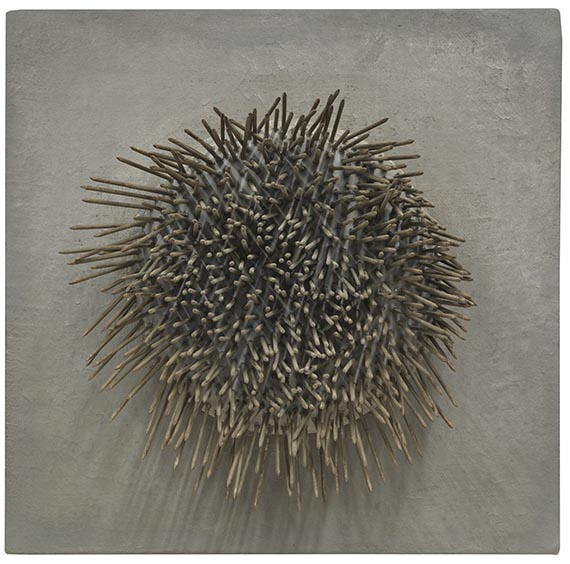
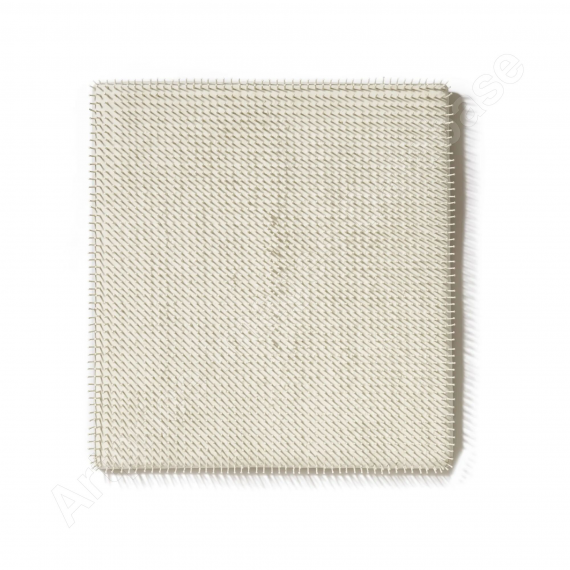
Taktile Struktur Rotierend, 1961.
. Nails, aluminum, and metallic paint over burl...
Estimate:
€ 150,000 - 200,000
$ 175,500 - 234,000
11
Günther Uecker
Taktile Struktur Rotierend, 1961.
. Nails, aluminum, and metallic paint over burl...
Estimate:
€ 150,000 - 200,000
$ 175,500 - 234,000
Günther Uecker
1930 - 2025
Taktile Struktur Rotierend. 1961.
Nails, aluminum, and metallic paint over burlap on wood, rotating.
Signed, dated, and with a direction arrow on the reverse. 60 x 60 x 18 cm (23.6 x 23.6 x 7 in). [JS].
• A unique work in metallic gray from the pinnacle of the “ZERO” period.
• The second work of the same title, “Taktile Struktur Rotierend” (1961), is part of the Peggy Guggenheim Collection in Venice.
• Light, movement, space: A captivating presentation of a rotating, three-dimensional interplay of light, shadow, and form.
• 1961: Uecker’s participation in the legendary “ZERO” exhibition at Alfred Schmela’s famous Düsseldorf avant-garde gallery.
• A radical new beginning for the European avant-garde: Together with Manzoni and Fontana, Uecker participated in the legendary exhibition “Nul 62” at the Stedelijk Museum in Amsterdam in 1962.
• Rigidity, power, and poetry: Uecker transforms the rigidity of the material and the force of its creation into aesthetics full of sensuality.
This work is registered in the Uecker Archive under the number GU.61.108 and is earmarked for inclusion in the forthcoming catalogue raisonné of Uecker’s works.
PROVENANCE: Private collection, Düsseldorf (until 2010)
Private collection, Germany (until 2012, Dorotheum)
Private collection, Baden-Baden (from the above)
Private collection, Switzerland (since 2016, from the above).
LITERATURE: See Dieter Honisch, *Uecker*, Stuttgart 1983, CR no. 254 (the work of the same title in the Guggenheim Collection, Venice, https://www.guggenheim.org/artwork/5119).
Dorotheum, Zeitgenössische Kunst / Contemporary Art, Thursday, November 29, 2012, cat. no. 1407 (illustrated)
See Angelica Zander Rudenstine, Peggy Guggenheim Collection, Venice, New York 1985, p. 727, cat. no. 173 (on the work in the Guggenheim Collection).
Called up: ca. 17.20 h +/- 20 min.
1930 - 2025
Taktile Struktur Rotierend. 1961.
Nails, aluminum, and metallic paint over burlap on wood, rotating.
Signed, dated, and with a direction arrow on the reverse. 60 x 60 x 18 cm (23.6 x 23.6 x 7 in). [JS].
• A unique work in metallic gray from the pinnacle of the “ZERO” period.
• The second work of the same title, “Taktile Struktur Rotierend” (1961), is part of the Peggy Guggenheim Collection in Venice.
• Light, movement, space: A captivating presentation of a rotating, three-dimensional interplay of light, shadow, and form.
• 1961: Uecker’s participation in the legendary “ZERO” exhibition at Alfred Schmela’s famous Düsseldorf avant-garde gallery.
• A radical new beginning for the European avant-garde: Together with Manzoni and Fontana, Uecker participated in the legendary exhibition “Nul 62” at the Stedelijk Museum in Amsterdam in 1962.
• Rigidity, power, and poetry: Uecker transforms the rigidity of the material and the force of its creation into aesthetics full of sensuality.
This work is registered in the Uecker Archive under the number GU.61.108 and is earmarked for inclusion in the forthcoming catalogue raisonné of Uecker’s works.
PROVENANCE: Private collection, Düsseldorf (until 2010)
Private collection, Germany (until 2012, Dorotheum)
Private collection, Baden-Baden (from the above)
Private collection, Switzerland (since 2016, from the above).
LITERATURE: See Dieter Honisch, *Uecker*, Stuttgart 1983, CR no. 254 (the work of the same title in the Guggenheim Collection, Venice, https://www.guggenheim.org/artwork/5119).
Dorotheum, Zeitgenössische Kunst / Contemporary Art, Thursday, November 29, 2012, cat. no. 1407 (illustrated)
See Angelica Zander Rudenstine, Peggy Guggenheim Collection, Venice, New York 1985, p. 727, cat. no. 173 (on the work in the Guggenheim Collection).
Called up: ca. 17.20 h +/- 20 min.
Bold, radical, and revolutionary: Alongside Piero Manzoni and Lucio Fontana, Günther Uecker was one of the pioneers of the European avant-garde movement in the early 1960s. It was the negation of painting that brought Uecker's famous nail paintings closer to the work of his European peers at the time. Like Fontana with his famous pierced canvases, the “Concetti Spaziali,” they pushed the boundaries of traditional panel painting. Around 1956/57, Uecker described his reduced, novel, and groundbreaking artistic concept in a way that made it seem like a kind of development of Fontana’s early “Concetti Spaziali,” the famous “Bucchi” (“Holes”): “Where two lines meet, there is a point; that’s where I put a nail... I determine the point...the shadow of the nail represents a new line....the movement of the shadow becomes the perception of time." In 1961, the year this work was created, Uecker joined the avant-garde group ZERO, founded by Otto Piene and Heinz Mack a few years earlier. These young, progressive artists collectively describe their radical new beginning in their 1963 “ZERO” manifesto with words that read almost like a description of the present work: “Zero is silence. Zero is the beginning. Zero is round. Zero rotates. Zero is the moon.” Silver-gray, round, and rotating, Uecker’s “Taktile Struktur Rotierend” exudes an aesthetically reduced aura that still captivates today’s observers. Like a distant planet, the monochromatic surface of the nail disc—brought to life by the play of light and shadow—seems to float against a dark background that recedes into mysterious depth. Depending on the rotation, angle, and shadow cast by the movably mounted nail necks extending into the space, it creates a whole new visual experience that, despite its minimalism, seems to offer endless variations.
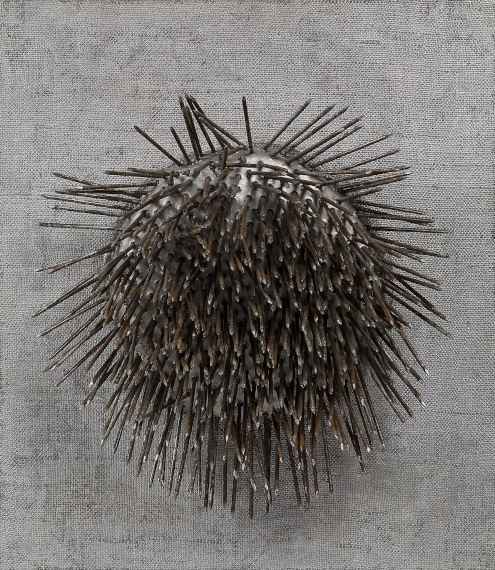
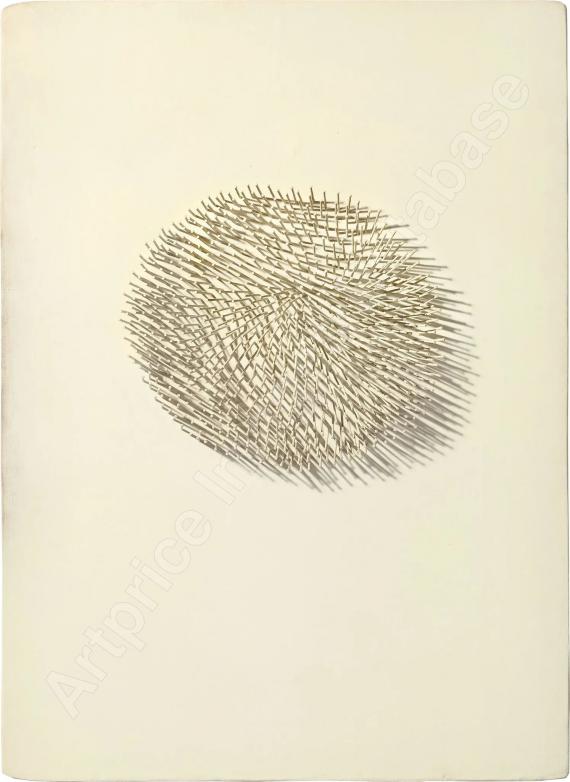
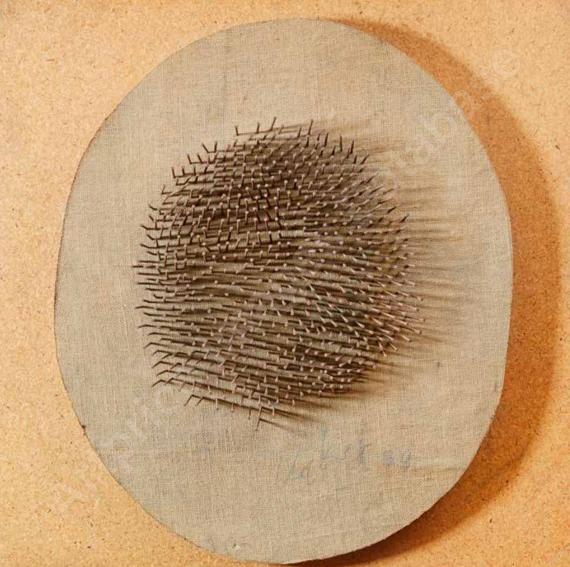
In historical terms, we are talking about the period after the unspeakable horrors of World War II, the moment when Germany had begun to rise from the rubble and face up to its historical guilt. At this pivotal moment, this young, avant-garde group of German artists was also promoting a radically purified, artistic new beginning on an aesthetic level. Uecker’s revolutionary work, in particular, set a clear and, to this day, unmistakable mark in this regard: monochromatic, three-dimensional, and powerfully nailed, Uecker created a completely unprecedented visual experience in his early nail pictures, which emerged in the early 1960s. The light and the shadows cast by the nail heads—which shift depending on the viewer’s vantage point—create an interactive aesthetic experience that extends from the wall into the room, thereby achieving an intensely sensory connection between art and space. At the same time, this artistic approach was also adopted by various other avant-garde artists across Europe, primarily in Germany, Italy, and the Netherlands: Manzoni’s “Achromes,” which extends the boundaries of the canvas into space, and Lucio Fontana’s famous “Concetti spaziali” are among the best-known positions of this aesthetically reduced movement. Like Uecker’s famous nail paintings, they also pushed the boundaries of classic panel painting and count among the most prominent negations of traditional painting in postwar European art. Uecker had just graduated from the Düsseldorf Academy and was in his early thirties when he created his first nail paintings and nail objects, which would henceforth become the international hallmark of his oeuvre. Our “Taktile Struktur Rotierend” is not only an early but also an outstanding example of this groundbreaking artistic work. Along with the slightly smaller composition “Taktile Struktur Rotierend,” also created in 1961 and now in the Guggenheim Collection in Venice, only one other comparable work of this type is known. Here, too, Uecker mounted a rotating disc with freely moving, long nail shafts in front of a rectangular painting surface. In addition to the gently shimmering color scheme in metallic silver-gray—extremely rare in Uecker’s oeuvre—it is also the extraordinary arrangement of the nails that earns these two works a prominent place in Uecker’s oeuvre: It is not the nail heads, but the arrow-like tips of the long, freely movable nail shafts that jut out toward viewers in these two unique nail paintings. Uecker’s nails seem to come alive, almost like a dense bundle of Mikado sticks, held mid-throw and just about to spread out across the surface from its center. And yet, it is a particularly quiet, almost cosmic-meditative aura that distinguishes these two outstanding creations in a special way. In 1961, Günther Uecker also participated in the legendary exhibition “ZERO. Edition, Exposition, Demonstration” at Alfred Schmela’s famous avant-garde gallery in Düsseldorf. And as early as 1962, one year after the creation of this work, Uecker’s nail pictures were presented alongside works by Fontana and Manzoni in the exhibition “Nul 62” at the Stedelijk Museum in Amsterdam, a show devoted to the radical new beginning of the European avant-garde. [JS]
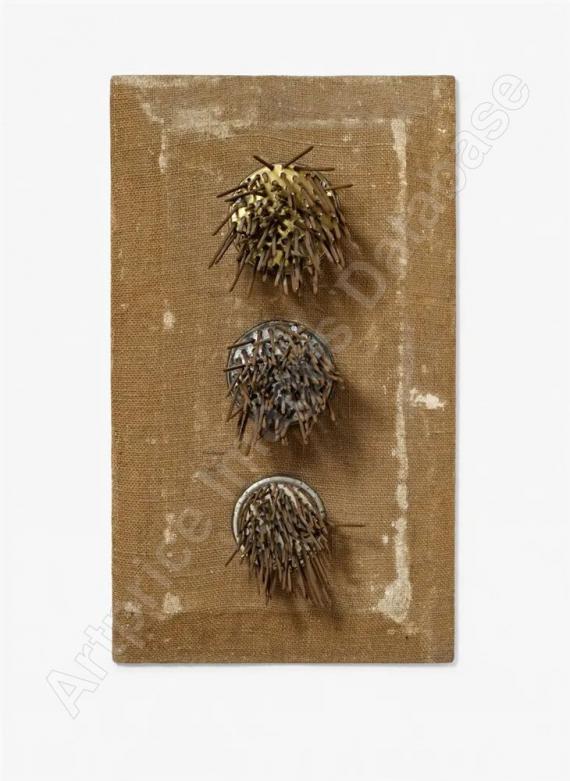
Günther Uecker, Taktile Struktur Rotierend (Tactile Structure Rotating), 1961, mixed media, nails, aluminum, and metallic paint on burlap on wood, rotating, The Solomon R. Guggenheim Foundation Peggy Guggenheim Collection, Venice. © VG Bild-Kunst, Bonn 2026
In historical terms, we are talking about the period after the unspeakable horrors of World War II, the moment when Germany had begun to rise from the rubble and face up to its historical guilt. At this pivotal moment, this young, avant-garde group of German artists was also promoting a radically purified, artistic new beginning on an aesthetic level. Uecker’s revolutionary work, in particular, set a clear and, to this day, unmistakable mark in this regard: monochromatic, three-dimensional, and powerfully nailed, Uecker created a completely unprecedented visual experience in his early nail pictures, which emerged in the early 1960s. The light and the shadows cast by the nail heads—which shift depending on the viewer’s vantage point—create an interactive aesthetic experience that extends from the wall into the room, thereby achieving an intensely sensory connection between art and space. At the same time, this artistic approach was also adopted by various other avant-garde artists across Europe, primarily in Germany, Italy, and the Netherlands: Manzoni’s “Achromes,” which extends the boundaries of the canvas into space, and Lucio Fontana’s famous “Concetti spaziali” are among the best-known positions of this aesthetically reduced movement. Like Uecker’s famous nail paintings, they also pushed the boundaries of classic panel painting and count among the most prominent negations of traditional painting in postwar European art. Uecker had just graduated from the Düsseldorf Academy and was in his early thirties when he created his first nail paintings and nail objects, which would henceforth become the international hallmark of his oeuvre. Our “Taktile Struktur Rotierend” is not only an early but also an outstanding example of this groundbreaking artistic work. Along with the slightly smaller composition “Taktile Struktur Rotierend,” also created in 1961 and now in the Guggenheim Collection in Venice, only one other comparable work of this type is known. Here, too, Uecker mounted a rotating disc with freely moving, long nail shafts in front of a rectangular painting surface. In addition to the gently shimmering color scheme in metallic silver-gray—extremely rare in Uecker’s oeuvre—it is also the extraordinary arrangement of the nails that earns these two works a prominent place in Uecker’s oeuvre: It is not the nail heads, but the arrow-like tips of the long, freely movable nail shafts that jut out toward viewers in these two unique nail paintings. Uecker’s nails seem to come alive, almost like a dense bundle of Mikado sticks, held mid-throw and just about to spread out across the surface from its center. And yet, it is a particularly quiet, almost cosmic-meditative aura that distinguishes these two outstanding creations in a special way. In 1961, Günther Uecker also participated in the legendary exhibition “ZERO. Edition, Exposition, Demonstration” at Alfred Schmela’s famous avant-garde gallery in Düsseldorf. And as early as 1962, one year after the creation of this work, Uecker’s nail pictures were presented alongside works by Fontana and Manzoni in the exhibition “Nul 62” at the Stedelijk Museum in Amsterdam, a show devoted to the radical new beginning of the European avant-garde. [JS]

Buyer's premium, taxation and resale right compensation for Günther Uecker "Taktile Struktur Rotierend"
This lot can be purchased subject to differential or regular taxation, artist‘s resale right compensation is due.
Differential taxation:
Hammer price up to 2,000,000 €: herefrom 34 % premium.
The share of the hammer price exceeding 2,000,000 € is subject to a premium of 29 % and is added to the premium of the share of the hammer price up to 2,000,000 €.
The share of the hammer price exceeding 4,000,000 € is subject to a premium of 22 % and is added to the premium of the share of the hammer price up to 4,000,000 €.
The buyer's premium contains VAT, however, it is not shown.
Regular taxation:
Hammer price up to 2,000,000 €: herefrom 29 % premium.
The share of the hammer price exceeding 2,000,000 € is subject to a premium of 23% and is added to the premium of the share of the hammer price up to 2,000,000 €.
The share of the hammer price exceeding 4,000,000 € is subject to a premium of 15% and is added to the premium of the share of the hammer price up to 4,000,000 €.
The statutory VAT of currently 7 % is levied to the sum of hammer price and premium.
We kindly ask you to notify us before invoicing if you wish to be subject to regular taxation.
Calculation of artist‘s resale right compensation:
For works by living artists, or by artists who died less than 70 years ago, a artist‘s resale right compensation is levied in accordance with Section 26 UrhG:
4 % of hammer price from 400.00 euros up to 50,000 euros,
another 3 % of the hammer price from 50,000.01 to 200,000 euros,
another 1 % for the part of the sales proceeds from 200,000.01 to 350,000 euros,
another 0.5 % for the part of the sale proceeds from 350,000.01 to 500,000 euros and
another 0.25 % of the hammer price over 500,000 euros.
The maximum total of the resale right fee is EUR 12,500.
The artist‘s resale right compensation is VAT-exempt.
Differential taxation:
Hammer price up to 2,000,000 €: herefrom 34 % premium.
The share of the hammer price exceeding 2,000,000 € is subject to a premium of 29 % and is added to the premium of the share of the hammer price up to 2,000,000 €.
The share of the hammer price exceeding 4,000,000 € is subject to a premium of 22 % and is added to the premium of the share of the hammer price up to 4,000,000 €.
The buyer's premium contains VAT, however, it is not shown.
Regular taxation:
Hammer price up to 2,000,000 €: herefrom 29 % premium.
The share of the hammer price exceeding 2,000,000 € is subject to a premium of 23% and is added to the premium of the share of the hammer price up to 2,000,000 €.
The share of the hammer price exceeding 4,000,000 € is subject to a premium of 15% and is added to the premium of the share of the hammer price up to 4,000,000 €.
The statutory VAT of currently 7 % is levied to the sum of hammer price and premium.
We kindly ask you to notify us before invoicing if you wish to be subject to regular taxation.
Calculation of artist‘s resale right compensation:
For works by living artists, or by artists who died less than 70 years ago, a artist‘s resale right compensation is levied in accordance with Section 26 UrhG:
4 % of hammer price from 400.00 euros up to 50,000 euros,
another 3 % of the hammer price from 50,000.01 to 200,000 euros,
another 1 % for the part of the sales proceeds from 200,000.01 to 350,000 euros,
another 0.5 % for the part of the sale proceeds from 350,000.01 to 500,000 euros and
another 0.25 % of the hammer price over 500,000 euros.
The maximum total of the resale right fee is EUR 12,500.
The artist‘s resale right compensation is VAT-exempt.
Headquarters
Joseph-Wild-Str. 18
81829 Munich
Phone: +49 89 55 244-0
Fax: +49 89 55 244-177
info@kettererkunst.de
Louisa von Saucken / Undine Schleifer
Holstenwall 5
20355 Hamburg
Phone: +49 40 37 49 61-0
Fax: +49 40 37 49 61-66
infohamburg@kettererkunst.de
Dr. Simone Wiechers / Nane Schlage
Fasanenstr. 70
10719 Berlin
Phone: +49 30 88 67 53-63
Fax: +49 30 88 67 56-43
infoberlin@kettererkunst.de
Cordula Lichtenberg
Gertrudenstraße 24-28
50667 Cologne
Phone: +49 221 510 908-15
infokoeln@kettererkunst.de
Hessen
Rhineland-Palatinate
Miriam Heß
Phone: +49 62 21 58 80-038
Fax: +49 62 21 58 80-595
infoheidelberg@kettererkunst.de
We will inform you in time.