


Frame image
37
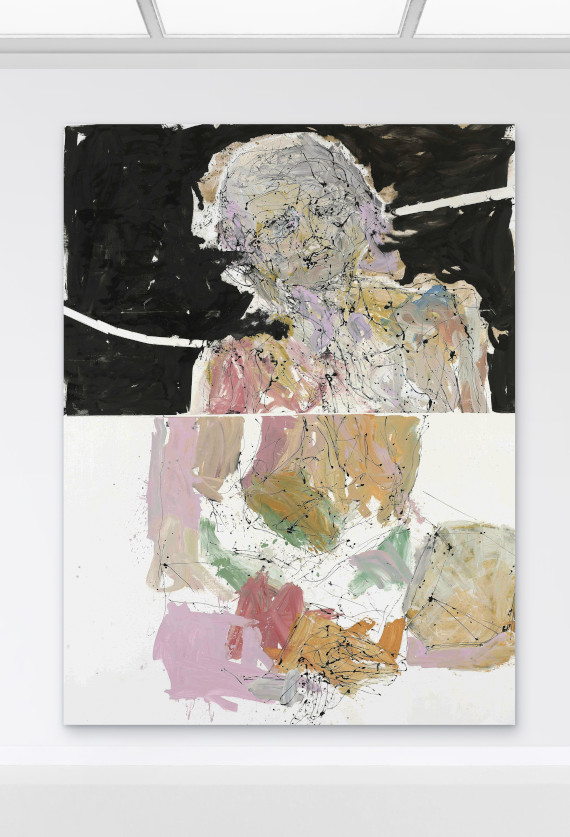
Georg Baselitz
Enddesign, 2011.
Oil and gold bronze on canvas
Estimate:
€ 550,000 / $ 638,000 Sold:
€ 967,500 / $ 1,122,300 (incl. surcharge)
37
Georg Baselitz
Enddesign, 2011.
Oil and gold bronze on canvas
Estimate:
€ 550,000 / $ 638,000 Sold:
€ 967,500 / $ 1,122,300 (incl. surcharge)
Georg Baselitz
1938 - 2026
Enddesign. 2011.
Oil and gold bronze on canvas.
Signed, dated dated “24. XII. 2011”, and titled on the reverse. 400 x 300 cm (157.4 x 118.1 in).
• Dürer/Friedrich/Baselitz: With this monumental work, Baselitz joins the ranks of the great masters of art history.
• Remix & Adaptation: a radical reevaluation of his important ‘Fraktur’ paintings from the 1960s, inspired by Dürer’s iconic “Melencolia I.”
• Spontaneous drawing, dripping, and momentum in an impressive format.
• Purchased from the Gagosian Gallery, New York, by a prominent private collector in New York.
• Recent major retrospective exhibitions at the Fondation Beyeler, Basel (2018), the Centre Pompidou, Paris (2021/22), the Kunsthistorisches Museum, Vienna (2023), and White Cube, London (2024)..
We are grateful to the Georg Baselitz Archive in Munich for the kind support in cataloging this lot. The work is registered in the artist’s archive.
PROVENANCE: Gagosian Gallery, New York.
Private collection, New York (acquired from the above in 2012).
EXHIBITION: Gagosian Gallery, New York, Georg Baselitz, February 28-April 7, 2012.
LITERATURE: John-Paul Stonard, Georg Baselitz: Paris, Potsdam, New York, The Burlington Magazine, New York 2012, pp. 366–367 (illustrated, here under the title “Enddesign”).
Georg Baselitz, Robert Fleck, Georg Baselitz. New paintings and sculpture, New York 2012, pp. 25–27 (here under the title “Enddesign”).
Georg Baselitz, quoted from: Gagosian Gallery, New York (https://gagosian.com/artists/georg-baselitz/).
1938 - 2026
Enddesign. 2011.
Oil and gold bronze on canvas.
Signed, dated dated “24. XII. 2011”, and titled on the reverse. 400 x 300 cm (157.4 x 118.1 in).
• Dürer/Friedrich/Baselitz: With this monumental work, Baselitz joins the ranks of the great masters of art history.
• Remix & Adaptation: a radical reevaluation of his important ‘Fraktur’ paintings from the 1960s, inspired by Dürer’s iconic “Melencolia I.”
• Spontaneous drawing, dripping, and momentum in an impressive format.
• Purchased from the Gagosian Gallery, New York, by a prominent private collector in New York.
• Recent major retrospective exhibitions at the Fondation Beyeler, Basel (2018), the Centre Pompidou, Paris (2021/22), the Kunsthistorisches Museum, Vienna (2023), and White Cube, London (2024)..
We are grateful to the Georg Baselitz Archive in Munich for the kind support in cataloging this lot. The work is registered in the artist’s archive.
PROVENANCE: Gagosian Gallery, New York.
Private collection, New York (acquired from the above in 2012).
EXHIBITION: Gagosian Gallery, New York, Georg Baselitz, February 28-April 7, 2012.
LITERATURE: John-Paul Stonard, Georg Baselitz: Paris, Potsdam, New York, The Burlington Magazine, New York 2012, pp. 366–367 (illustrated, here under the title “Enddesign”).
Georg Baselitz, Robert Fleck, Georg Baselitz. New paintings and sculpture, New York 2012, pp. 25–27 (here under the title “Enddesign”).
Georg Baselitz, quoted from: Gagosian Gallery, New York (https://gagosian.com/artists/georg-baselitz/).
Artist=Genius: Baselitz’s monumental “Enddesign” and Dürer’s famous engraving “Melencolia I”
Monumental, in technical perfection and of great depth: Baselitz’s painting “Enddesign” is an artistic tour de force that covers more than five hundred years of art history and artistic identity with apparent ease and spontaneity. Not only the title of this enormous painting, but above all, the enigmatic figure gazing into the distance and the iconic image of the octahedron are unmistakable references to Dürer. Baselitz refers to the progenitor of the artistic genius cult, the Renaissance artist Albrecht Dürer, and his technically masterful and highly complex copper engraving “Melencolia I” from 1514. Dürer’s “Melencolia I” is an icon of Western art history and one of the world’s most famous artworks. Its technical perfection and enigmatic depiction continue to captivate to this day, making it widely regarded as the most discussed work in art history. Baselitz, who has compiled an extensive collection of Old Master prints and has repeatedly drawn on their complex motifs as a source of inspiration for his own painting, also seeks an intensive engagement with Dürer’s famous masterpiece.
Dürer was a painter, printmaker, mathematician, and art theorist, and, in the spirit of the Renaissance man, viewed his art not merely as the result of a technical creative process, but as the essence of an intense intellectual act of creation. For him, the artist is, first and foremost, a creative thinker in a special sense, who must master a wide variety of fields of knowledge—such as anatomy, geometry, and perspective—and be well-read in every respect. The melancholic temperament, which was still viewed negatively in the Middle Ages, undergoes a positive reinterpretation in Renaissance Neoplatonic literature, drawing on a passage in the “Problemata” of the ancient philosopher Aristotle (4th century B.C.). Dürer was the first to visually represent these attributes in his “Melencolia I,” portraying the figure—through the multitude of accompanying attributes—as a highly intellectual being and thus as a comprehensive allegory of creativity. "The melancholic, viewed with great skepticism in the Middle Ages, advanced to the class of geniuses, to which many, including Dürer, strove to belong. Melancholy and genius now became mutually dependent. Researchers such as Schuster rightly speak of a ‘hidden self-portrait’ [..]” (R. Schoch/M. Mende/A. Scherbaum, Albrecht Dürer. Das druckgraphische Werk, vol. 1, Munich 2001, p. 183).
In “Enddesign,” Baselitz references not only the most famous work of art history, but also the artwork that is regarded as a kind of artistic spark for the modern artistic identity, since it perceives the artist as an intellectual or even a genius for the first time.
Remix & Adaptation: Baselitz’s “Enddesign” as a complex pictorial abstraction
The visual reception of Dürer’s “Melencolia I” played a decisive role in shaping the modern understanding of art. More than 300 years later, Caspar David Friedrich—another exceptional German artist—referred to Dürer in his woodcut “Melancholy (Woman with a Spider’s Web Among Bare Trees)” (1803/04), which summarizes the basic artistic mood of Romanticism on a single sheet. And in 1998, Georg Baselitz created his monumental painting “Friedrichs Melancholie”, an homage to Friedrich, for the staircase of the Berlin Reichstag building, the seat of the German Bundestag, thereby erecting a painterly monument not only to himself but also, for the first time, to the two great masters of German art history, Albrecht Dürer and Caspar David Friedrich.
In “Enddesign,” however, Baselitz took a significant step forward thirteen years later, enriching his homage to the two great masters of art history with his characteristic remix elements, quotes from art history, and references to his own work, thereby expertly bridging the gap into the 21st century. Thus, “Enddesign” strikingly embodies the melancholic-romantic mood that Baselitz declares to be the artistic principle of his mature phase: “This idea of ‘looking toward the future’ is nonsense. I realized that simply going backward is better. You stand at the rear of the train—looking at the tracks flying back below—or you stand at the stern of a boat and look back—looking back at what’s gone.”
Georg Baselitz, quoted from: Gagosian Gallery, New York (https://gagosian.com/artists/georg-baselitz/).
Graphic spontaneity, dripping, and energy: technical mastery on an impressive scale
Despite its complex content and dense composition, “Enddesign” captivates with its airy, light-painting style, which appears to be applied freely to the canvas—a result of Baselitz’s consistent artistic evolution, while also incorporating stylistic references ranging from Edward Munch to Willem de Kooning and Tracey Emin. First, Baselitz applied bold brushstrokes to create loosely arranged areas of color on the massive canvas draped on the floor; in a second step, he spread an extremely fine, drawing-like grid of black drippings over them to give the color fields visual stability and depth. As a connoisseur and conqueror of tradition, Baselitz distinguishes his work in terms of technical composition as well, since he by no means establishes the contour first, but rather acts in a deliberately counterintuitive manner to generate a completely novel visual experience. His outstanding painterly quality is also evident in the division of the pictorial surface and the dramatic shift in subject matter, which Baselitz derived from his “Fraktur” drawings of the late 1960s and elevated to a monumental scale.
As early as 1995, the Solomon R. Guggenheim Museum in New York and the Los Angeles County Museum of Art presented the first Baselitz retrospective exhibitions in the United States. Since then, numerous major international museum exhibitions dedicated to the German painter have followed, including at the Fondation Beyeler in Basel (2018), the Centre Pompidou in Paris (2021/22), and the Kunsthistorisches Museum in Vienna (2023). Today, Georg Baselitz is represented by Galerie Thaddeus Ropac Gallery in Paris, London, and Salzburg, and by Gagosian in New York, London, and Paris. [JS]
Monumental, in technical perfection and of great depth: Baselitz’s painting “Enddesign” is an artistic tour de force that covers more than five hundred years of art history and artistic identity with apparent ease and spontaneity. Not only the title of this enormous painting, but above all, the enigmatic figure gazing into the distance and the iconic image of the octahedron are unmistakable references to Dürer. Baselitz refers to the progenitor of the artistic genius cult, the Renaissance artist Albrecht Dürer, and his technically masterful and highly complex copper engraving “Melencolia I” from 1514. Dürer’s “Melencolia I” is an icon of Western art history and one of the world’s most famous artworks. Its technical perfection and enigmatic depiction continue to captivate to this day, making it widely regarded as the most discussed work in art history. Baselitz, who has compiled an extensive collection of Old Master prints and has repeatedly drawn on their complex motifs as a source of inspiration for his own painting, also seeks an intensive engagement with Dürer’s famous masterpiece.
Dürer was a painter, printmaker, mathematician, and art theorist, and, in the spirit of the Renaissance man, viewed his art not merely as the result of a technical creative process, but as the essence of an intense intellectual act of creation. For him, the artist is, first and foremost, a creative thinker in a special sense, who must master a wide variety of fields of knowledge—such as anatomy, geometry, and perspective—and be well-read in every respect. The melancholic temperament, which was still viewed negatively in the Middle Ages, undergoes a positive reinterpretation in Renaissance Neoplatonic literature, drawing on a passage in the “Problemata” of the ancient philosopher Aristotle (4th century B.C.). Dürer was the first to visually represent these attributes in his “Melencolia I,” portraying the figure—through the multitude of accompanying attributes—as a highly intellectual being and thus as a comprehensive allegory of creativity. "The melancholic, viewed with great skepticism in the Middle Ages, advanced to the class of geniuses, to which many, including Dürer, strove to belong. Melancholy and genius now became mutually dependent. Researchers such as Schuster rightly speak of a ‘hidden self-portrait’ [..]” (R. Schoch/M. Mende/A. Scherbaum, Albrecht Dürer. Das druckgraphische Werk, vol. 1, Munich 2001, p. 183).
In “Enddesign,” Baselitz references not only the most famous work of art history, but also the artwork that is regarded as a kind of artistic spark for the modern artistic identity, since it perceives the artist as an intellectual or even a genius for the first time.
Remix & Adaptation: Baselitz’s “Enddesign” as a complex pictorial abstraction
The visual reception of Dürer’s “Melencolia I” played a decisive role in shaping the modern understanding of art. More than 300 years later, Caspar David Friedrich—another exceptional German artist—referred to Dürer in his woodcut “Melancholy (Woman with a Spider’s Web Among Bare Trees)” (1803/04), which summarizes the basic artistic mood of Romanticism on a single sheet. And in 1998, Georg Baselitz created his monumental painting “Friedrichs Melancholie”, an homage to Friedrich, for the staircase of the Berlin Reichstag building, the seat of the German Bundestag, thereby erecting a painterly monument not only to himself but also, for the first time, to the two great masters of German art history, Albrecht Dürer and Caspar David Friedrich.
In “Enddesign,” however, Baselitz took a significant step forward thirteen years later, enriching his homage to the two great masters of art history with his characteristic remix elements, quotes from art history, and references to his own work, thereby expertly bridging the gap into the 21st century. Thus, “Enddesign” strikingly embodies the melancholic-romantic mood that Baselitz declares to be the artistic principle of his mature phase: “This idea of ‘looking toward the future’ is nonsense. I realized that simply going backward is better. You stand at the rear of the train—looking at the tracks flying back below—or you stand at the stern of a boat and look back—looking back at what’s gone.”
Georg Baselitz, quoted from: Gagosian Gallery, New York (https://gagosian.com/artists/georg-baselitz/).
Graphic spontaneity, dripping, and energy: technical mastery on an impressive scale
Despite its complex content and dense composition, “Enddesign” captivates with its airy, light-painting style, which appears to be applied freely to the canvas—a result of Baselitz’s consistent artistic evolution, while also incorporating stylistic references ranging from Edward Munch to Willem de Kooning and Tracey Emin. First, Baselitz applied bold brushstrokes to create loosely arranged areas of color on the massive canvas draped on the floor; in a second step, he spread an extremely fine, drawing-like grid of black drippings over them to give the color fields visual stability and depth. As a connoisseur and conqueror of tradition, Baselitz distinguishes his work in terms of technical composition as well, since he by no means establishes the contour first, but rather acts in a deliberately counterintuitive manner to generate a completely novel visual experience. His outstanding painterly quality is also evident in the division of the pictorial surface and the dramatic shift in subject matter, which Baselitz derived from his “Fraktur” drawings of the late 1960s and elevated to a monumental scale.
As early as 1995, the Solomon R. Guggenheim Museum in New York and the Los Angeles County Museum of Art presented the first Baselitz retrospective exhibitions in the United States. Since then, numerous major international museum exhibitions dedicated to the German painter have followed, including at the Fondation Beyeler in Basel (2018), the Centre Pompidou in Paris (2021/22), and the Kunsthistorisches Museum in Vienna (2023). Today, Georg Baselitz is represented by Galerie Thaddeus Ropac Gallery in Paris, London, and Salzburg, and by Gagosian in New York, London, and Paris. [JS]

Headquarters
Joseph-Wild-Str. 18
81829 Munich
Phone: +49 89 55 244-0
Fax: +49 89 55 244-177
info@kettererkunst.de
Louisa von Saucken / Undine Schleifer
Holstenwall 5
20355 Hamburg
Phone: +49 40 37 49 61-0
Fax: +49 40 37 49 61-66
infohamburg@kettererkunst.de
Dr. Simone Wiechers / Nane Schlage
Fasanenstr. 70
10719 Berlin
Phone: +49 30 88 67 53-63
Fax: +49 30 88 67 56-43
infoberlin@kettererkunst.de
Cordula Lichtenberg
Gertrudenstraße 24-28
50667 Cologne
Phone: +49 221 510 908-15
infokoeln@kettererkunst.de
Hessen
Rhineland-Palatinate
Miriam Heß
Phone: +49 62 21 58 80-038
Fax: +49 62 21 58 80-595
infoheidelberg@kettererkunst.de
We will inform you in time.