


Frame image
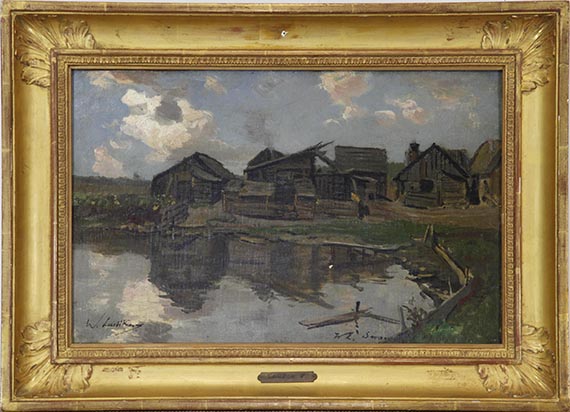
Raumbeispiel
343
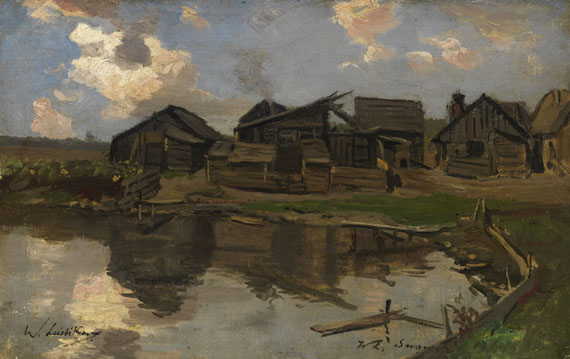
Walter Leistikow
Swaroschin (Polen), Nach 1889.
Oil on canvas, laminated on cardboard
Estimate:
€ 6,000 / $ 6,900 Sold:
€ 7,500 / $ 8,625 (incl. surcharge)
343
Walter Leistikow
Swaroschin (Polen), Nach 1889.
Oil on canvas, laminated on cardboard
Estimate:
€ 6,000 / $ 6,900 Sold:
€ 7,500 / $ 8,625 (incl. surcharge)
Swaroschin (Polen). Nach 1889.
Oil on canvas, laminated on cardboard.
Lower left signed. Monogrammed and inscribed in right of bottom center. Verso with inscription and numbered. 30 x 45.3 cm (11.8 x 17.8 in).
PROVENANCE: Collection Rock (until 1910: Lepke November 22, 1910).
Collection Walter (acquired from the above).
Ron Krausz art dealer, Munich.
Private collection Lower Saxony (acquired from the above in 2012).
LITERATURE: Rudolph Lepke's Kunst-Auctions-Haus Berlin, Gemälde erster Meister unserer Zeit, auction on November 22, 1910, lot 48.
Oil on canvas, laminated on cardboard.
Lower left signed. Monogrammed and inscribed in right of bottom center. Verso with inscription and numbered. 30 x 45.3 cm (11.8 x 17.8 in).
PROVENANCE: Collection Rock (until 1910: Lepke November 22, 1910).
Collection Walter (acquired from the above).
Ron Krausz art dealer, Munich.
Private collection Lower Saxony (acquired from the above in 2012).
LITERATURE: Rudolph Lepke's Kunst-Auctions-Haus Berlin, Gemälde erster Meister unserer Zeit, auction on November 22, 1910, lot 48.
Walter Leistikow, who played a major role in setting the stage for the advent of modernism in Berlin, is widely recognized as one of the most defining artists of the turn of the century. In 1883, at the age of 17, he left his home town of Bromberg, West Prussia, to attend the Berlin Academy. In his biography of the artist, which was published two years after Leistikow's death, Lovis Corinth, with whom Leistikow formed a close friendship after some initial animosity, wrote that his friend was dismissed from the Academy after six months due to his “lack of talent” (The Life of Walter Leistikow. A Piece of Berlin’s Cultural History, Berlin: Cassirer 1910). No doubt, this was the kind of anti-academic seal of approval that typified the advent of modernist movements around the year 1900. Leistikow finally approached the private studio of Hans Gude, a Norwegian landscape painter of the Düsseldorf School. His first motifs, which he found in the Berlin countryside and his native Pomerania, are entirely rooted in an understated, sincere realism that nevertheless exhibits hints of the delicately tinged color atmosphere of the later Symbolist period. In 1892, Leistikow was among the co-founders of the “Vereinigung der XI” (Association of the XI) group, named simply after the number of its members. Foregoing a mandatory artistic program, the group demanded fundamental changes concerning the selection criteria dictated by jury decisions at exhibitions. A decade later, in 1903, Leistikow and Harry Graf Kessler were involved in the establishment of the Deutscher Künstlerbund (German Artists’ Association) in Weimar. [KT]

Headquarters
Joseph-Wild-Str. 18
81829 Munich
Phone: +49 89 55 244-0
Fax: +49 89 55 244-177
info@kettererkunst.de
Louisa von Saucken / Undine Schleifer
Holstenwall 5
20355 Hamburg
Phone: +49 40 37 49 61-0
Fax: +49 40 37 49 61-66
infohamburg@kettererkunst.de
Dr. Simone Wiechers / Nane Schlage
Fasanenstr. 70
10719 Berlin
Phone: +49 30 88 67 53-63
Fax: +49 30 88 67 56-43
infoberlin@kettererkunst.de
Cordula Lichtenberg
Gertrudenstraße 24-28
50667 Cologne
Phone: +49 221 510 908-15
infokoeln@kettererkunst.de
Hessen
Rhineland-Palatinate
Miriam Heß
Phone: +49 62 21 58 80-038
Fax: +49 62 21 58 80-595
infoheidelberg@kettererkunst.de
We will inform you in time.